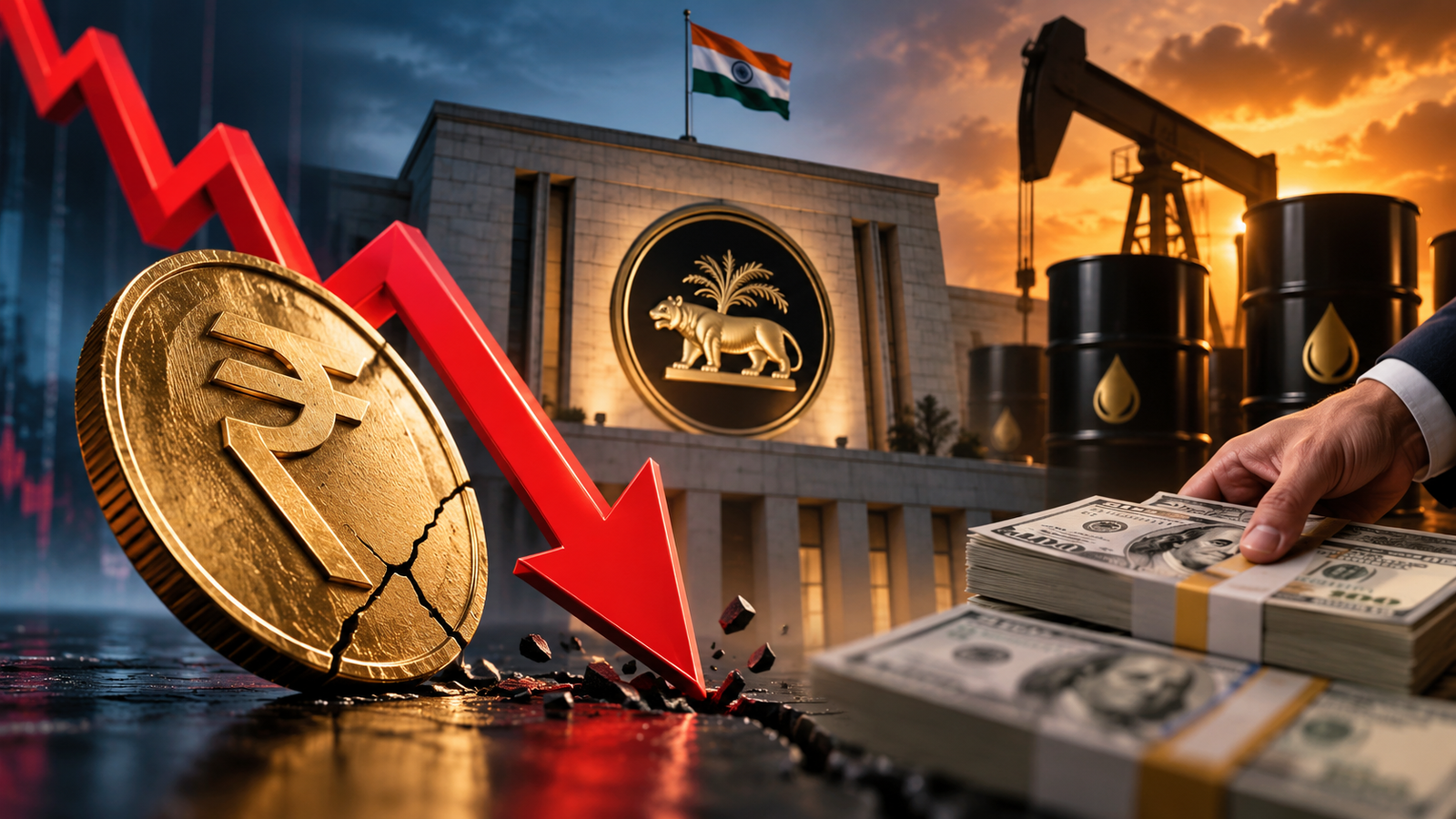
The Indian rupee came under fresh pressure as higher crude oil prices raised demand for US dollars. On September 8, the rupee traded at ₹94.68 per US dollar, down 0.2% on the day at the point cited by Reuters. State-run banks were seen offering dollars near the ₹94.70 level. Two bankers and a foreign exchange trader told Reuters that such activity was likely on behalf of the Reserve Bank of India, or RBI.
The key point is that the reported RBI action should be viewed as a market assessment, not as a formal public confirmation of a specific transaction. The RBI does not need to disclose every foreign exchange operation at the time it occurs. As a result, market participants often use price action and activity at state-run banks to assess whether the central bank has entered the market.
This distinction matters from a legal and analytical point of view. It would be too strong to state as a fact that the RBI sold a particular amount of dollars at ₹94.70 unless the central bank itself confirms that transaction. The safer conclusion is that market participants believed the RBI was present through state-run banks and that such activity helped limit the speed of the rupee’s decline.
What the ₹94.68 Level Means
A rate of ₹94.68 per US dollar means that one US dollar cost ₹94.68 in the foreign exchange market at that point. A weaker rupee means that more Indian rupees are required to buy one dollar.
The 0.2% decline is modest when viewed on its own. It does not, by itself, establish a currency crisis or a disorderly market. The larger issue is the direction of pressure and the factors behind it.
The rupee has faced pressure from crude oil prices, demand for dollars from importers and wider global market conditions. India is a major oil importer, so a higher international oil price can raise the country’s dollar requirement. That can place pressure on the rupee if other sources of dollar supply do not rise by a similar amount.
The current oil shock has a strong geopolitical element. Brent crude moved toward $100 per barrel as tensions in the Middle East increased and concern about possible supply disruption grew. Reuters reported Brent at $97.50 a barrel on September 8 and close to $100 on September 9.
Why the RBI May Enter the Market
A central bank can use its foreign exchange reserves to affect market liquidity and reduce sharp currency moves. In simple terms, if there is strong demand for dollars, the central bank can provide dollars to the market. This can reduce immediate pressure on the local currency.
The purpose does not have to be a permanent defence of one exact exchange rate. Central bank action can also aim to reduce sudden moves and limit excessive volatility.
Recent reports suggest that the RBI has been active in the foreign exchange market for several weeks. Reuters reported that the central bank had used regular, and at times forceful, intervention during the recent period. This helped the rupee reach a more than two-month high late last week.
A separate report cited estimates from six bankers that the RBI may have sold at least $8 billion during the previous week. Those bankers placed the possible amount at between $8 billion and $15 billion. The same report said the rupee reached ₹94.2850 on September 3. These figures are estimates from market participants and should not be treated as official RBI data unless the central bank confirms them.
| Reported market data | Figure |
|---|---|
| Rupee level cited on September 8 | ₹94.68 per US dollar |
| Daily move at that point | Down 0.2% |
| State-run bank dollar offers | Around ₹94.70 |
| Brent crude on September 8 | $97.50 per barrel |
| Estimated RBI dollar sales last week | At least $8 billion |
| Wider banker estimate for last week | $8 billion–$15 billion |
| Rupee level on September 3 | ₹94.2850 |
| Reported September 8 session close | ₹94.8175 |
| September 9 intraday low reported by Reuters | ₹95.2250 |
The table brings out an important point. The reported RBI presence did not mean that the rupee could not fall. It meant that there was evidence of official market support while private demand for dollars remained strong.
Oil Is the Main External Risk
Crude oil is one of the most important factors in the current currency story.
When oil becomes more expensive, Indian buyers need more dollars to pay for the same volume of crude. If the country pays a higher import bill, the demand for foreign currency can rise. That does not automatically mean that the rupee must fall, because many other factors affect the exchange rate. However, all else equal, a higher oil bill can create pressure on the currency.
The latest move has a clear geopolitical link. Brent crude moved toward $100 per barrel amid a sharp increase in Middle East tensions. Reuters reported that Brent reached $99.02 on September 9, while West Texas Intermediate stood at $93.95.
For India, the concern goes beyond the foreign exchange market. Higher crude can also affect inflation, transport costs, corporate expenses and the wider trade balance. Reuters noted that India is the world’s third-largest oil importer and is therefore highly sensitive to oil price shocks.
The effect on the rupee can therefore work through several channels. A higher oil bill can increase dollar demand. Higher inflation risk can affect interest-rate expectations. Global investors can also become more cautious toward emerging markets during periods of geopolitical stress.
The ₹95 Level Has Market Importance
The rupee later moved through the ₹95-per-dollar level. Reuters reported an intraday low of ₹95.2250 on September 9. The move came despite indications that the RBI was present in the market.
The breach of ₹95 matters because traders often place orders around major round-number levels. Reuters reported that stop-loss sales added to the pressure once the rupee moved beyond ₹95. In simple terms, some market positions may have been closed automatically after the currency crossed that level, which can add to a short-term move.
This does not mean ₹95 is an official RBI target or a legally defined support level. It is better described as a market reference point.
Reports on September 9 also suggested that the RBI could try to protect the ₹95 area, while the expected trading range was about ₹94.50 to ₹95.25. Such estimates come from market participants and should not be treated as official policy guidance.
RBI Intervention Has Limits
Foreign exchange intervention can reduce the speed of a currency move, but it cannot remove the economic cause of that move.
If oil prices remain high for a long period, the underlying demand for dollars may remain strong. In that situation, the RBI may face a choice between greater use of its foreign exchange reserves and greater tolerance for rupee weakness.
This does not mean that the RBI has run out of options. Monetary policy, liquidity conditions, reserve management and communication can all affect market expectations. The central bank also has substantial foreign exchange reserves. A recent market report estimated that reserves were likely above $750 billion, although that figure should be treated as a reported estimate rather than an official figure unless confirmed by the RBI.
The more reasonable interpretation is that intervention can provide time and reduce volatility. It cannot guarantee a fixed exchange rate when the external environment remains adverse.
Why the Latest Move Is Different
The recent pressure differs from a purely domestic currency event because the main trigger appears to be external.
Crude oil prices have moved sharply higher due to geopolitical developments. At the same time, global markets have faced uncertainty over US interest rates, inflation and the path of the US dollar.
Reuters reported that markets were pricing roughly a 60% chance of a US Federal Reserve rate increase at the time of its September 8 report. A US inflation report due on Friday was also seen as an important market event.
Higher US interest rates can support the dollar because they can make US assets more attractive relative to assets in some other markets. The effect is not automatic, and exchange rates depend on many variables, but the possibility can add pressure to emerging-market currencies.
That means the rupee currently faces pressure from more than one direction. Oil affects India’s external payments. Global rate expectations affect capital flows and the dollar. Geopolitical risk can reduce investor appetite for riskier assets.
What the Market Data Does Not Prove
The available reports do not prove that the RBI has a fixed target of ₹95 per dollar. They also do not prove that the central bank will defend that level at any cost.
They do not establish that the RBI intends to prevent any further rupee decline. Nor do they prove that every dollar sale by a state-run bank was made directly for the central bank.
The phrase “likely selling dollars” is therefore important. It reflects the assessment of traders and bankers who observed market activity. Reuters attributed the assessment to market sources rather than to an official RBI statement.
This wording is more appropriate than a statement such as “the RBI is selling dollars to stop the rupee from falling.” The latter presents an inference as a confirmed fact and also assumes a policy objective that may not have been publicly stated.
Impact on Inflation and the Economy
A weaker rupee can make imports more expensive when prices are set in US dollars. Oil is the most important concern at present because crude has a large role in India’s import bill.
If both crude prices and the dollar rise against the rupee, the local cost of imported energy can increase further. That can affect fuel costs, transport and other parts of the economy.
However, the final effect on inflation depends on several factors. Global commodity prices, domestic demand, government policy, tax levels, supply conditions and the extent to which companies absorb higher costs can all change the outcome.
It would therefore be premature to say that the current rupee move will automatically create a large inflation shock. The correct conclusion is that the risk has increased because the rupee is weaker while crude is close to $100 per barrel.
Impact on Indian Financial Markets
Currency weakness can also affect Indian equities, although the effect varies by company and sector.
Companies that earn a large share of their revenue in dollars may receive some benefit from a weaker rupee when those dollar earnings are converted into rupees. Export-oriented businesses can therefore have a different currency exposure from firms that depend heavily on imported inputs.
Import-heavy businesses face the opposite risk. A weaker rupee can raise the local cost of imported goods, energy or raw materials.
The broader equity market can also react to the macroeconomic effect. Reuters reported that the Nifty 50 fell 0.67% to 23,474.4 and the Sensex fell 0.83% to 74,954.33 on September 9, while the Nifty IT index fell 3%. These moves occurred alongside higher crude prices and wider geopolitical concerns.
These market moves should not be attributed only to the rupee. Equity prices reflect many factors at once, and the available data does not establish a single cause for the full market decline.
What Could Matter Next
The next phase of the rupee story is likely to depend on crude oil, the RBI’s market presence, global dollar demand and US monetary policy expectations.
If crude moves back below the recent highs, some pressure on the rupee could ease. If crude remains close to or above $100 per barrel, the demand for dollars may stay firm.
The RBI may continue to provide liquidity during periods of sharp market pressure. Yet the size and duration of any such action cannot be known with certainty from market observations alone.
A sustained move above ₹95 would therefore be more significant than a brief intraday move. It would suggest that external pressure is strong enough to overcome at least part of the recent official support. That still would not, by itself, establish a long-term trend.
A Balanced Reading of the Situation
The most cautious reading is that the RBI appears to have been active in the foreign exchange market while the rupee has faced strong external pressure from crude oil and global risk conditions.
The move to ₹94.68 on September 8, down 0.2%, was not by itself an extreme currency event. The greater concern came from the fact that crude was close to $100 per barrel and the rupee later crossed ₹95.
The available evidence suggests that RBI action helped reduce the speed of the currency’s decline, but it did not remove the economic pressure on the rupee. Reuters reported that the RBI likely intervened on both September 8 and September 9, although the market response suggested that its presence was less forceful than during the earlier phase of the recent rupee rally.
This does not necessarily signal a change in RBI policy. It may simply show the practical limits of intervention when the source of pressure comes from a major external shock.
Conclusion
The rupee’s move to ₹94.68 per dollar, down 0.2% at the cited point on September 8, came at a time when crude oil prices were close to $100 per barrel. Market participants reported signs of RBI support through state-run banks, but there was no official confirmation of each reported transaction.
The later move beyond ₹95 shows that central bank intervention cannot fully isolate the rupee from global energy and financial conditions. On September 9, the rupee reached an intraday low of ₹95.2250 as Brent crude moved close to $100.
For now, the strongest analytical conclusion is not that the RBI has lost control of the rupee, nor that the currency must continue to weaken. The evidence supports a narrower view: the RBI appears to have used market intervention to reduce pressure, while higher oil prices and wider global risks have made that task more difficult.
The next direction of the rupee will depend on whether the external shock fades or persists. If oil prices ease, the pressure could reduce. If crude remains near $100 and dollar demand stays strong, the RBI may face a more difficult balance between reserve use, market stability and tolerance for further rupee weakness.
All figures and market observations above reflect reports available on September 9, 2026. References to probable RBI action, trader views, future currency levels or possible policy effects are analytical interpretations and should not be read as confirmed RBI statements, investment advice or a prediction of future exchange rates.
ALSO READ: Korean Semiconductor Rally: A Cautious Market Analysis