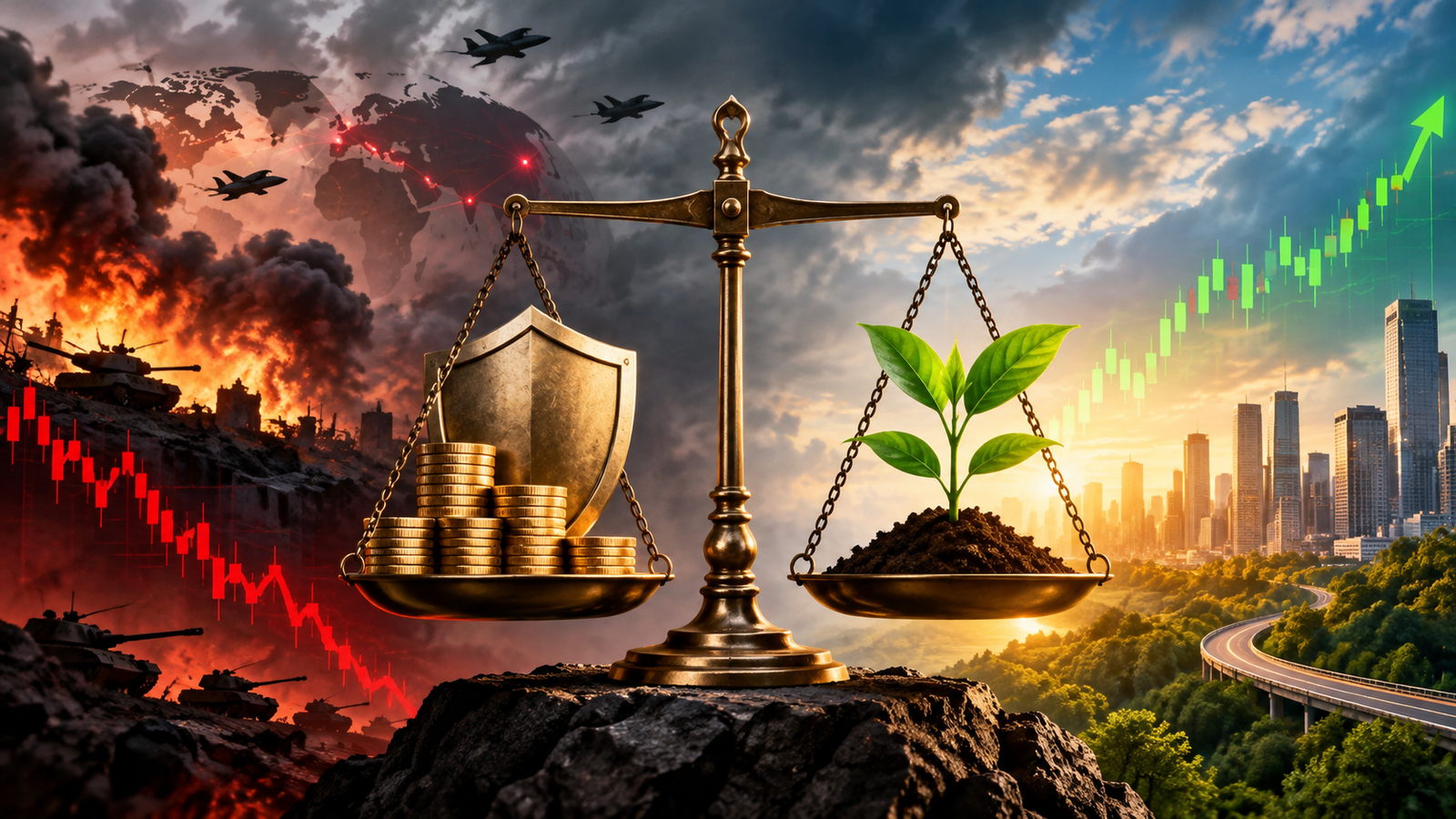
Geopolitical shocks can change the business environment very quickly. A conflict can push up oil prices, disrupt trade routes, raise freight costs and create problems for supply chains. Companies may also face higher insurance costs, currency pressure and weaker demand.
In such a situation, investors often change what they value. Before the shock, the market may focus on revenue growth, profit growth and future expansion. After the shock, the first question can become much simpler: Can the company handle the pressure without damage to its finances?
This is where balance sheets matter. A company with low debt, strong cash flow and good interest coverage has more room to deal with a difficult period. It can absorb higher costs without a major change to its business plan.
This does not mean growth stops mattering. It means the order of priorities can change. During the first phase of a geopolitical shock, financial strength can matter more than fast growth.
The first test is financial strength
A strong balance sheet gives a company time. This is very important when the future is hard to predict.
A business with high debt has regular payments that it cannot easily avoid. If profits fall while interest costs and working capital needs rise, pressure can build very fast. Management may then have to cut investment, sell assets or raise fresh capital at an unattractive price.
A company with less debt has a different position. It can use its cash reserves, maintain its investment plans and wait for conditions to improve.
Recent data from Crisil shows why this matters. Its stress test covered 34 sectors, which represented 65% of its rated corporate debt. Under a prolonged West Asia conflict, with supply-chain disruption for nine months and crude oil at an average of $110 per barrel, corporate operating profitability could fall by about 200 basis points from the earlier expectation of around 12%.
Yet the effect on credit quality was much smaller for most companies because of stronger balance sheets.
India Inc has a useful cushion
One of the most important numbers in the Crisil study is corporate gearing.
Over the past decade, median gearing for corporate India has fallen by half to about 0.5 times as of March 2026. At the same time, interest coverage has doubled to more than 5 times.
These figures matter because they show how much the corporate sector has improved before the shock arrived.
Lower debt means lower financial pressure. Higher interest coverage means companies have a larger cushion between their operating profit and interest costs.
This does not make businesses immune to a crisis. It simply gives them more room to absorb the first blow.
That difference can become very important when markets turn nervous.
Growth alone may not protect a company
High growth looks attractive in normal conditions. Investors may pay a high valuation for a company that can grow revenue and profit at a fast pace.
But growth can become less useful if it requires large amounts of capital.
Imagine two companies. One grows at 20% but carries heavy debt. The other grows at 10% but has very little debt and produces strong free cash flow.
In a stable economy, the first company may look more attractive. During a geopolitical shock, the second company can become more valuable because it has fewer financial risks.
The fast-growing company may face higher borrowing costs, weaker demand and higher input prices at the same time. Its growth target may then become difficult to achieve.
The slower company can use its financial strength to protect its business.
This is why investors should not look at growth in isolation.
The real question is cash flow
Debt is only one part of the story. Cash flow may be even more important.
A company can report strong profit growth but still face cash problems if customers take longer to pay or if inventory costs rise sharply.
Geopolitical shocks can create exactly these problems. Companies may need more inventory because supply chains become less reliable. They may also have to pay suppliers sooner while receiving money from customers later.
This raises working capital needs.
A business with strong free cash flow can handle this pressure more easily. A weak business may need more borrowing just to keep normal operations alive.
That is why quality should include cash generation, not just low debt.
Pricing power becomes very valuable
Another important feature is pricing power.
When oil, freight, packaging or other inputs become more expensive, a company needs to decide how much of that cost it can pass to customers.
A company with a strong brand or limited competition may raise prices without losing much demand. A weaker company may have to absorb the higher cost.
Crisil’s May 2026 stress test found that 22 of the 34 sectors could see operating profitability fall by more than 10% under the prolonged-conflict case. However, even partial cost pass-through could protect revenue growth in many sectors.
This shows why business quality and financial quality should be considered together.
Low debt helps a company survive the shock. Pricing power helps protect its profits.
Growth can return once the shock fades
The story does not end with survival.
Once the shock becomes less severe, investors usually return to the question of future earnings. At that stage, growth can become important again.
This creates a two-part investment case.
First, the company needs enough financial strength to survive the difficult period. Second, it needs a strong business model that can produce growth after conditions improve.
The best companies can offer both.
Crisil’s June 2026 assessment showed how quickly the picture can change when geopolitical conditions improve. After a US-Iran memorandum and the reopening of the Strait of Hormuz, its estimated impact on operating margins fell to about 100 basis points, compared with the earlier 200-basis-point stress case.
This is important because it shows that a shock does not necessarily destroy long-term growth. Some pressure can disappear once supply conditions improve.
Strong companies can gain market share
There is another reason strong balance sheets matter.
A crisis can create opportunities for financially strong companies.
Weak competitors may cut capital spending. They may delay new products, reduce staff or sell assets. Some may struggle to meet debt payments.
A financially strong company does not have to make the same cuts.
It can continue to invest, keep its employees, support customers and expand capacity. If weaker rivals retreat, the stronger company can gain market share.
In this case, the balance sheet is not only protection. It becomes a competitive advantage.
That is why the strongest investment case is not simply a company with low debt. It is a company that can use its financial strength to grow when others cannot.
The danger of defensive stocks
There is, however, a limit to the balance-sheet argument.
A company can have almost no debt and still be a poor investment.
If revenue does not grow, returns on capital fall and there are few new opportunities, a strong balance sheet may not create much shareholder value.
Some companies with high ROCE, low debt and large dividends have still seen weak share performance because growth has slowed and cash conversion has weakened.
This is an important lesson.
Financial strength is necessary for resilience, but it is not enough for long-term returns.
Investors still need to ask what the company can do with its capital.
What investors should look for
A useful definition of quality after a geopolitical shock is therefore broader than debt.
The ideal company has a strong balance sheet, healthy free cash flow, high interest coverage and manageable working capital needs. It also has pricing power, a good competitive position and a clear path for future growth.
Return on capital matters too.
If a company can take one dollar of capital and turn it into a high return, it has a better chance of creating value over time. If it can do this without excessive debt, the investment case becomes stronger.
Valuation also matters. Even an excellent business can produce poor returns if investors pay too much for it.
Balance sheet first, growth second
So, do balance sheets matter more than growth after a geopolitical shock?
In the short term, usually yes. In the long term, not necessarily.
During the first stage of a shock, investors care more about survival, cash flow and financial flexibility. A strong balance sheet can protect a company when costs rise and demand becomes uncertain.
Once the shock starts to fade, growth becomes important again. Investors want companies that can increase revenue, expand margins and earn strong returns on new capital.
The best businesses therefore combine both qualities.
They have enough financial strength to survive a crisis, but enough growth potential to create value after the crisis.
That is the real meaning of quality.
After a geopolitical shock, the market may reward companies for their ability to survive first. But over time, it rewards them for their ability to compound.