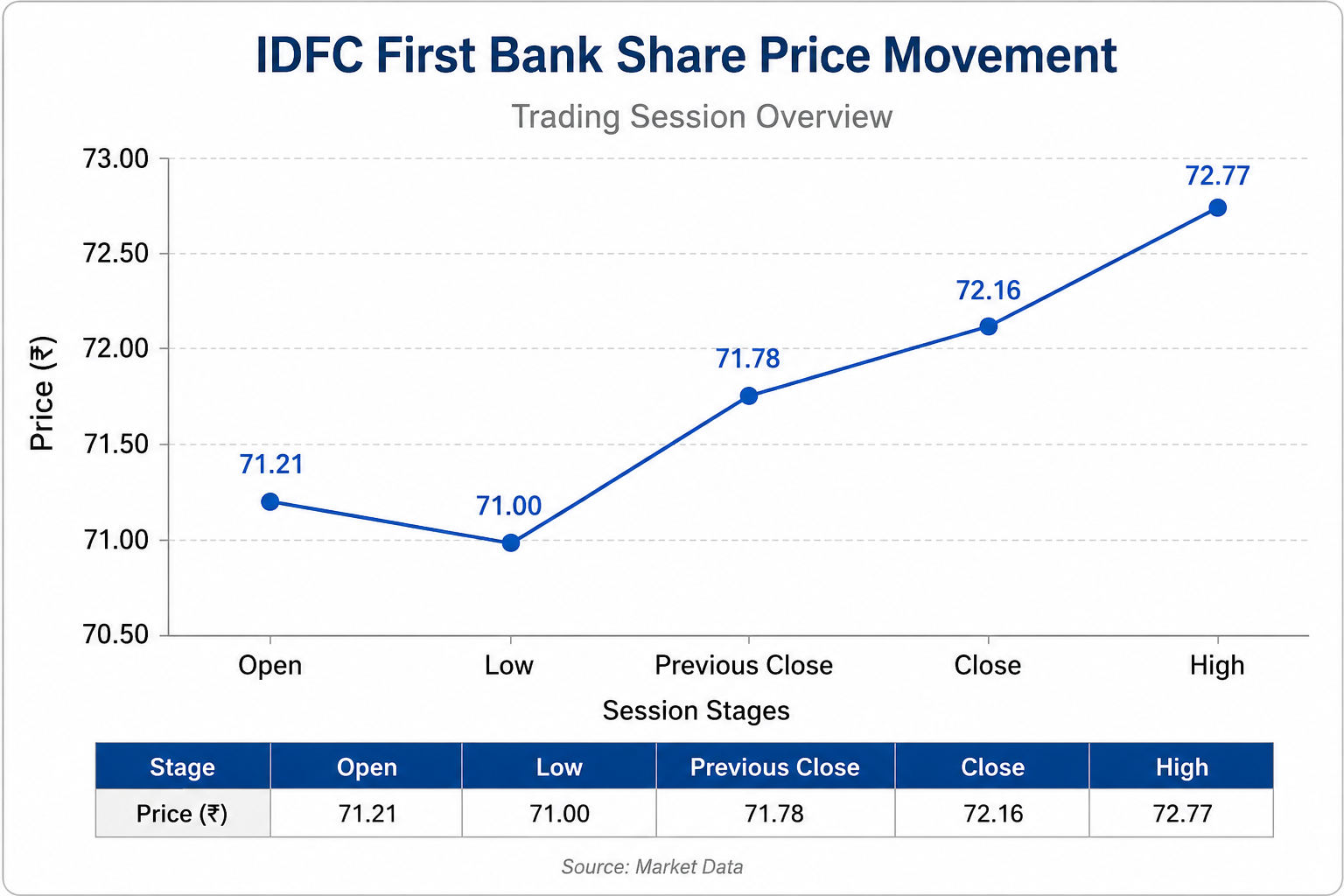
IDFC First Bank share price saw a steady rise in the latest trading session. The stock moved from the previous close of ₹71.78 and ended near ₹72.16. The gain may look small on paper, but the move caught market attention because investor mood around the bank has started to improve after months of pressure.
The stock opened at ₹71.21 during the session. Buyers slowly entered through the day and pushed the price higher. The stock touched a high of ₹72.77 before it settled near the closing level. Trading activity also stayed healthy as the VWAP came near ₹72.18.
The rise did not come from one single reason. Several financial, business, and market factors worked together. Investors now believe the bank may enter a more stable phase after recent challenges.
Market Movement Snapshot
Recovery Hope After Insurance Payout
One of the biggest reasons behind the positive move came from the recent insurance payout linked to the microfinance business. IDFC First Bank received ₹514.82 crore under the Credit Guarantee Fund for Micro Units scheme.
This amount may help the bank reduce earlier provisions linked to stressed loans. Investors see this as a positive sign because lower provisions can improve profit numbers in future quarters.
The market usually reacts well when banks show better control over bad loans. In this case, the insurance payout gave confidence that the pressure from the microfinance segment may slowly reduce.
Many investors now expect credit costs to fall over the next few quarters. This expectation created fresh buying interest in the stock.
Better Profit Outlook Supports Sentiment
The insurance recovery also improved expectations around earnings. Analysts believe the bank may report stronger profitability if provision pressure declines.
Over the last few quarters, many investors stayed cautious because higher provisions reduced profit growth. Now the situation looks more balanced.
A stronger profit outlook matters a lot for banking stocks. When earnings visibility improves, long-term investors usually return to the counter.
This change in mood played an important role in the latest price move.
Fraud Concerns Start To Fade
Earlier this year, the bank faced pressure after reports linked to suspected fraud in a Haryana-based account. The news created fear among investors and led to heavy selling in the stock.
However, recent market behaviour shows that investors no longer see the issue as a major long-term threat. The bank already shared details about corrective steps and internal controls.
As panic reduced, confidence slowly returned. This shift helped the stock recover from lower levels.
In the banking sector, trust matters more than almost anything else. Once investors feel the problem remains under control, selling pressure usually slows down.
That is exactly what seems to happen in the case of IDFC First Bank.
Banking Sector Mood Turns Positive
Another important factor came from the overall banking sector. Private banks have seen better investor interest in recent sessions.
The market expects stable loan growth and improving business activity across the economy. Lower pressure on funding costs also supported sentiment.
When the banking sector performs well, mid-sized banks like IDFC First Bank also receive attention from traders and institutional investors.
Sector-wide optimism often lifts stock prices even without major company-specific news.
ALSO READ: Near 52-Week Highs vs Near Lows: A Split Market
Strong Capital Position Gives Comfort
Investors also feel more comfortable because of the bank’s strong capital position. Earlier, global investment firms like Warburg Pincus and ADIA backed the bank through major investments.
This support strengthened market confidence.
A strong capital base gives banks more flexibility. It helps them grow loans, improve technology, and handle future stress without immediate pressure.
Many investors now believe the bank has enough strength to manage difficult periods while still focusing on expansion.
That belief supported fresh buying in the stock.
Large Investors Improve Confidence
The presence of global investors often creates a positive image in the market. When respected investment firms put money into a bank, smaller investors usually see it as a sign of trust.
Warburg Pincus and ADIA remain important names in global finance. Their involvement improved confidence around the long-term future of IDFC First Bank.
This factor may not create sharp one-day rallies, but it slowly improves investor perception over time.
Market participants now believe the bank has stronger institutional backing compared to earlier years.
Valuation Still Looks Attractive
Some investors also entered the stock because they believe valuation remains reasonable compared to larger private banks.
Even after recent recovery, many traders feel the stock still trades at lower levels compared to its long-term growth potential.
Value buying usually appears when investors think the downside risk remains limited.
This kind of buying creates gradual support during market dips and helps stocks maintain positive momentum.
Dividend Signal Adds Strength
The bank’s dividend announcement also supported sentiment. A dividend usually sends a message that management feels comfortable about capital and future business conditions.
For investors, this acts as a confidence signal.
Banks under major financial pressure normally avoid dividend payouts. Because of this, the market often reacts positively when a bank announces returns for shareholders.
The move helped improve overall investor mood around the stock.
Market Starts To See Stability Ahead
The biggest change may actually come from investor psychology. For several months, the market focused mostly on stress, provisions, and uncertainty around the bank.
Now the discussion has started to shift toward recovery, stability, and future growth.
That change in narrative matters a lot in the stock market.
Once investors believe the worst phase may have passed, fresh money slowly enters the stock. Even small positive news then creates stronger reactions on the upside.
This appears to be one of the key reasons behind the latest move in IDFC First Bank shares.
DFC First Bank Share Price Analysis After Recent Move
Strong Recovery Signs Appear In IDFC First Bank Shares
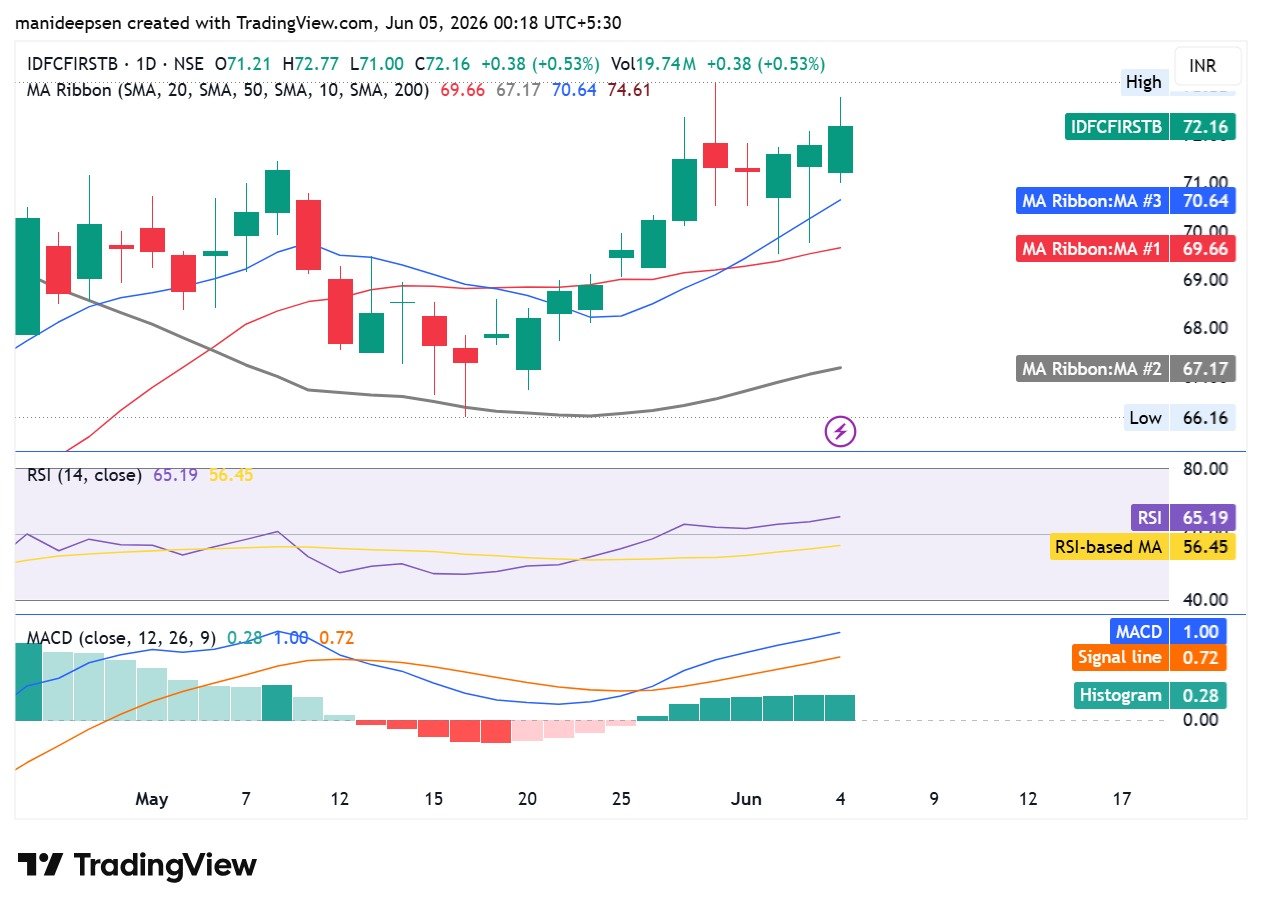
IDFC First Bank shares showed fresh strength after a difficult phase earlier this year. The stock closed near ₹72.16 after it opened at ₹71.21. During the trading session, the share touched a low of ₹71.00 and later climbed to a high of ₹72.77.
The move may look small in percentage terms, but market participants closely watched the stock because investor confidence has slowly improved in recent weeks.
The bank remains one of the well-known private sector lenders in India. It is also part of the NIFTY BANK index, which keeps the stock under constant focus from institutional investors and traders.
The recent price action shows that the market may now look beyond earlier concerns and focus more on long-term stability and business recovery.
ALSO READ: Why RBL Bank Share Price Jumped Strongly in May 2026
Share Performance Shows Mixed Trend
The stock performance across different time periods presents a mixed picture. In the short term, the share has shown better stability.
During the last one week, the stock gained 1.15%. At the same time, the benchmark comparison remained near negative 1.00%. This suggests the stock performed better than the broader comparison during the short period.
Over one month, the stock moved higher by 3.89%, while the comparison index showed a decline of 1.04%. This difference indicates fresh buying interest in the counter.
However, the longer-term picture still shows pressure.
The stock remains down 15.55% on a year-to-date basis. During the same period, the comparison figure stood near negative 9.05%. This shows the bank still carries the effect of earlier market weakness.
On a one-year basis, the share gained 7.13%, while the benchmark comparison showed a decline of 2.46%.
The three-year performance remained almost flat at negative 0.82%, but the broader comparison figure came near 23.60%.
The five-year return stands near 20.90%, while the comparison figure reached 53.88%.
This data suggests that the stock has faced periods of pressure despite strong phases in the broader banking sector.
Recent Recovery May Support Sentiment
Despite weak longer-term numbers, recent movement has started to improve market sentiment.
The stock recovered from its 52-week low of ₹58.08 recorded on 2 April 2026. Since then, the price has shown gradual improvement.
The 52-week high remains ₹87.00, which the stock touched on 2 January 2026.
This gap between the yearly high and current market price shows that the stock still trades below earlier peak levels. Some investors may view this as a possible recovery opportunity, while others may remain cautious because of earlier volatility.
The recent rise suggests the market may slowly rebuild confidence around the bank’s future outlook.
Trading Activity Reflects Healthy Participation
Trading data also shows active participation from market players.
The traded volume came near 197.44 lakh shares. The traded value stood at nearly ₹142.51 crore.
Such numbers indicate that investor activity remained healthy during the session.
The total market capitalisation of the bank currently stands near ₹62,256.87 crore. The free float market capitalisation remains around ₹47,813.90 crore.
A large free float usually supports better liquidity in the market. This allows smoother entry and exit for traders and institutional investors.
The impact cost remained near 0.03, which points toward stable liquidity conditions in the stock.
Delivery Numbers Show Investor Interest
The percentage of deliverable quantity compared to traded quantity came near 49.54%.
This figure often helps market participants understand whether traders prefer short-term activity or actual share delivery.
A higher delivery percentage may indicate stronger investor participation rather than only speculative trades.
Although delivery data alone cannot confirm future direction, it often provides clues about market behaviour during important sessions.
Valuation Remains Under Focus
The stock currently trades at a symbol P/E ratio of 38.38. The adjusted P/E also stands at 38.38.
This valuation level suggests that the market still expects future growth from the bank despite recent business pressure.
Banking stocks often trade on future earnings expectations rather than only current profits.
Some investors may see the valuation as expensive compared to traditional banking counters. Others may believe the bank still carries long-term growth potential because of its retail expansion strategy and improving balance sheet position.
Market opinion on valuation may continue to remain divided in the near term.
Volatility Still Exists In The Stock
The stock continues to show notable volatility.
Daily volatility stands near 2.06, while annualised volatility remains around 39.36.
This means the stock may continue to witness sharp short-term price swings.
Volatility usually rises when market participants react strongly to news flow, business developments, or changes in investor confidence.
For this reason, analysts often advise investors to study risk carefully before taking exposure to volatile banking stocks.
The current numbers suggest that the stock still carries active market interest along with elevated price movement.
Technical Trading Range Stays Important
The upper band for the stock currently stands at ₹78.95, while the lower band remains near ₹64.61.
The stock now trades between these important levels.
If the price continues to stay above lower support zones, investor confidence may improve further. On the other hand, weakness near support levels could again create pressure.
The tick size for the stock remains ₹0.01, while the face value stands at ₹10.00.
The applicable margin rate currently stays near 16.68%.
These figures remain important mainly for traders and derivatives market participants.
Listing Status And Sector Position Remain Strong
IDFC First Bank has remained listed since 6 November 2015.
The stock continues to hold active trading status in the market.
The bank belongs to the private sector banking industry, one of the most closely watched sectors in India.
Private banks often remain sensitive to interest rate movement, loan growth trends, asset quality, and overall economic conditions.
Because of this, market sentiment around banking shares can change quickly after major financial or economic updates.
ALSO READ: Hidden Signals Inside India’s Pre-Open Trade
Market Focus May Shift Toward Stability
The recent movement in IDFC First Bank shares shows that investors may slowly shift focus toward recovery and operational stability.
The stock still trades below earlier highs, but recent gains indicate that confidence has started to improve after months of uncertainty.
At the same time, volatility remains high and long-term returns still appear weaker compared to broader banking benchmarks.
This creates a balanced situation where both optimism and caution remain visible in the market.
Future movement may depend on profit growth, asset quality trends, credit demand, and overall banking sector conditions.
For now, the latest trading data suggests that the stock has entered a phase where investors closely monitor every sign of improvement.
Frequently Asked Questions
Why did IDFC First Bank share price rise recently?
IDFC First Bank share price moved higher because investor confidence improved after positive developments around the bank’s financial position. Market participants reacted positively to the insurance payout linked to stressed microfinance loans, expectations of lower provisions, and signs of better profit visibility. The banking sector also showed stable sentiment during the period, which supported the stock further.
Is IDFC First Bank still below its 52-week high?
Yes, the stock still trades below its 52-week high of ₹87.00 recorded on 2 January 2026. The recent closing price near ₹72.16 shows that the stock has recovered from its 52-week low of ₹58.08 touched on 2 April 2026, but it still remains far from earlier peak levels. This gap reflects both recovery potential and remaining market caution.
What does the current valuation of IDFC First Bank suggest?
The stock currently trades at a P/E ratio of 38.38. This indicates that the market still expects future growth from the bank despite earlier pressure on profitability. Some investors may view the valuation as expensive compared to traditional banking stocks, while others may see long-term value because of retail banking expansion and improving operational stability.
Why is volatility important for IDFC First Bank shares?
Volatility helps investors understand how sharply a stock price may move within short periods. IDFC First Bank currently shows daily volatility of 2.06 and annualised volatility of 39.36. These figures suggest that the stock may continue to witness strong price swings due to changing market sentiment, financial updates, and sector-related developments.
What factors may influence IDFC First Bank shares in the future?
Future price movement may depend on several important factors such as profit growth, loan demand, asset quality, provision levels, interest rate changes, and overall economic conditions. Investor confidence, quarterly earnings, and banking sector performance may also play a major role in shaping the stock’s future direction.
ALSO READ: Defensive Giants Draw Quiet Market Interest