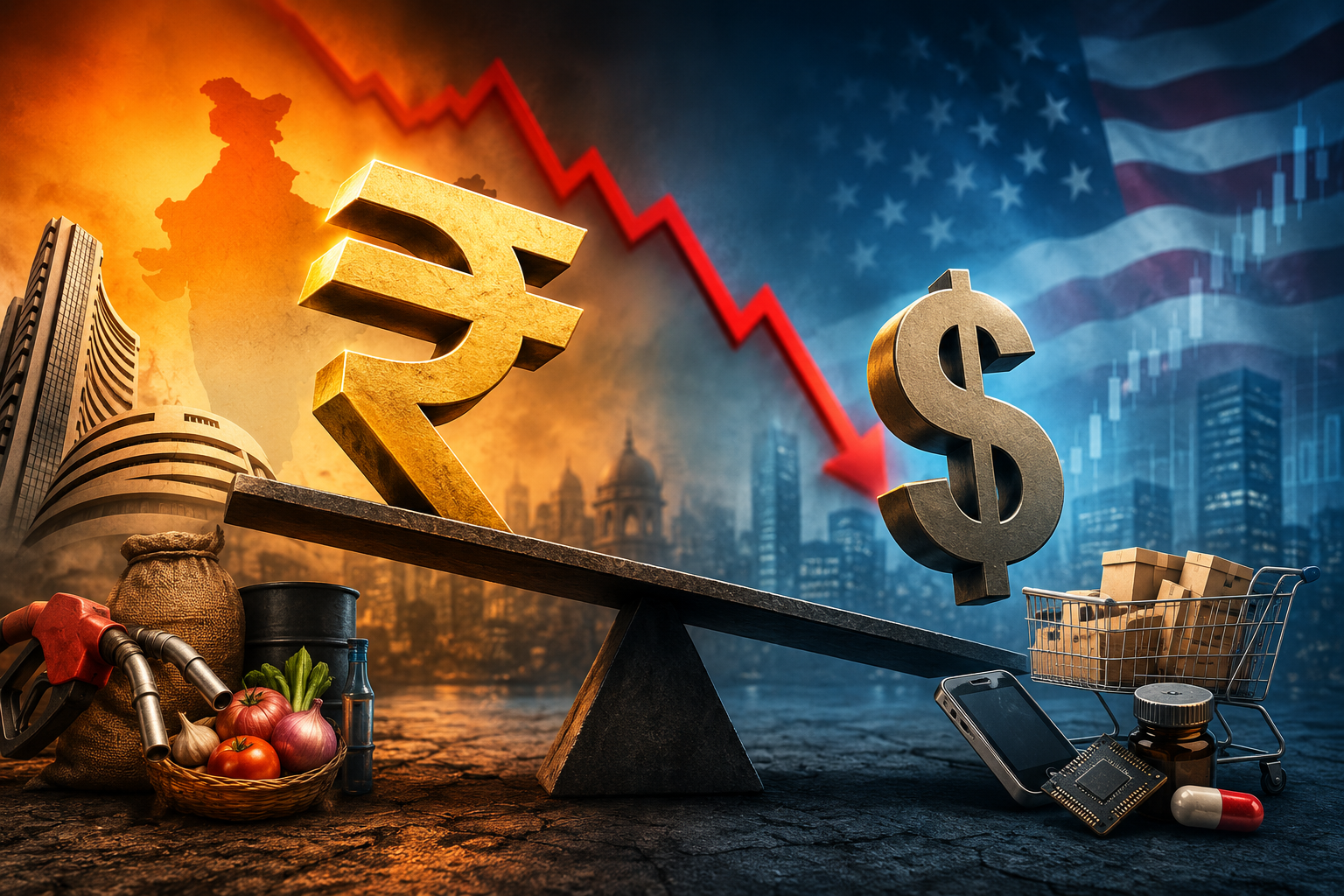
Recently, Dr. Shamika Ravi, a member of the Economic Advisory Council to the Prime Minister, made a statement that started a huge debate across social media and economic circles. She said, “So what if the rupee touches 100 to a dollar? It is just a number.”
The statement came at a time when people already worry about rising prices, weak purchasing power, and the future of the Indian economy. Supporters of the government defended the comment and said that a currency value alone does not decide whether a country is strong or weak.
But many economists, market experts, and ordinary citizens did not agree fully. They believe that a weak rupee can create serious pressure on India’s economy and daily life.
The debate is not really about the number 100. The debate is about what happens to India if the rupee keeps losing value against the US dollar.
Why the Government Is Defending the Situation
People close to the government say that the value of a currency should not create panic. They argue that many developed countries also have currencies that trade at weak levels against the dollar.
For example, the Japanese yen trades at a much weaker level than the dollar, yet Japan remains one of the world’s largest economies. Supporters of the government also say that India still remains one of the fastest growing major economies in the world.
Another argument says that a weak rupee can help exporters. When the rupee falls, Indian goods become cheaper in global markets. This can help sectors like IT services, textiles, manufacturing, and exports.
The government also points to stable growth numbers and strong tax collections as proof that the economy remains healthy despite currency pressure.
At first look, these arguments sound reasonable.
But they only show one side of the story.
Why a Weak Rupee Creates Problems
India still depends heavily on imports. The country buys large amounts of crude oil, electronic parts, semiconductors, medical equipment, and defence hardware from foreign countries.
Most global trade happens in US dollars.
This means India needs more rupees to buy the same products whenever the rupee loses value.
Suppose crude oil prices stay the same globally, but the rupee falls sharply. India will still pay more in rupee terms because the dollar becomes costlier.
This eventually affects common people.
Fuel prices rise. Transport costs rise. Delivery charges rise. Manufacturing costs rise. Companies pass these costs to consumers.
The final result appears in the form of inflation.
Inflation Does Not Stay Away Forever
Some people say inflation remains under control today. But currency weakness often creates slow pressure that becomes visible later.
A weak rupee affects almost every part of the economy because imports touch almost every industry.
When fuel becomes expensive, food transport also becomes expensive. Airline tickets become expensive. Imported electronics cost more. Machinery costs rise for factories.
Even small businesses feel pressure because many raw materials come from abroad.
Families may not notice the effect immediately, but over time purchasing power falls.
This is why central banks across the world monitor exchange rates carefully.
If currency value truly did not matter, countries would never try to protect their currencies.
RBI Action Shows the Real Concern
The Reserve Bank of India has taken several steps in recent months to support the rupee and attract dollar inflows into the country.
Reports from Reuters say policymakers expect billions of dollars through foreign investment and NRI deposits after new measures from the RBI.
If the rupee reaching 100 truly carried no risk, there would be no need for constant market intervention or policies to attract dollars.
The reality is simple.
Governments know that sharp currency weakness can damage investor confidence and create economic instability.
That is why RBI often enters the market to reduce sudden volatility.
Foreign Investors Also Watch the Rupee
Global investors pay close attention to currency movements.
Suppose a foreign investor earns profits in Indian stocks but loses money because the rupee weakens sharply. In that case, India becomes less attractive as an investment destination.
This can reduce foreign investment flows into the country.
A fall in investment creates more pressure on the rupee. This cycle can become dangerous if confidence weakens too much.
This is another reason why policymakers try hard to maintain stability in the currency market.
External Debt Becomes Costlier
Many Indian companies have loans in dollars.
When the rupee weakens, these companies need more rupees to repay the same debt.
This increases financial pressure on businesses and can reduce profits.
In some cases, companies may delay expansion plans or reduce hiring because repayment costs rise sharply.
A weak currency does not hurt everyone equally. Exporters may gain in the short term, but companies dependent on imports or foreign loans face serious pressure.
The Political Contrast Nobody Can Ignore
One of the biggest reasons this debate became viral is because people remember what happened in 2013.
At that time, the rupee traded around 63 to 64 against the dollar.
Many leaders from the BJP, then in opposition, called the situation dangerous and blamed the UPA government for economic mismanagement.
The falling rupee became a major political issue.
Statements from that period linked rupee weakness to weak leadership, poor policy decisions, and declining investor confidence.
At that time, crossing 60 itself created panic in political discussions.
Today, the same political establishment says that even 100 per dollar should not create concern.
This sharp difference raises obvious questions.
If 63 to a dollar looked alarming in 2013, how can 100 to a dollar suddenly become “just a number” today?
Economic logic cannot completely change based on who sits in power.
Either currency weakness mattered then and matters now, or political messaging changed according to convenience.
What Current Data Shows
The rupee stayed around 85 to 86 against the dollar during much of 2025.
Pressure on the currency came from several global and domestic reasons. These included a strong US dollar, oil price uncertainty, geopolitical tensions, and foreign investor outflows.
Reuters recently reported that Indian authorities introduced measures to attract foreign capital and support the rupee.
This itself shows that policymakers understand the importance of currency stability.
No government spends billions of dollars from reserves to defend something that carries no meaning.
The Real Issue Is Not the Number 100
The real issue is not whether the rupee touches 100.
The real issue is how and why it reaches that level.
If the rupee falls slowly because exports grow strongly and the economy remains stable, the impact may stay manageable.
But if the rupee falls because investors lose confidence, inflation rises, or foreign money exits the market, the consequences become dangerous.
A weak rupee affects fuel, inflation, imports, investments, debt repayment, and household expenses.
That is why ordinary people should not ignore the debate.
A currency is not just a number printed on a screen.
It reflects confidence in an economy.
And if policymakers truly believed the rupee did not matter, they would never spend so much energy trying to protect it.
Also Read – The Dark Truth Behind “Guaranteed” Crypto Returns