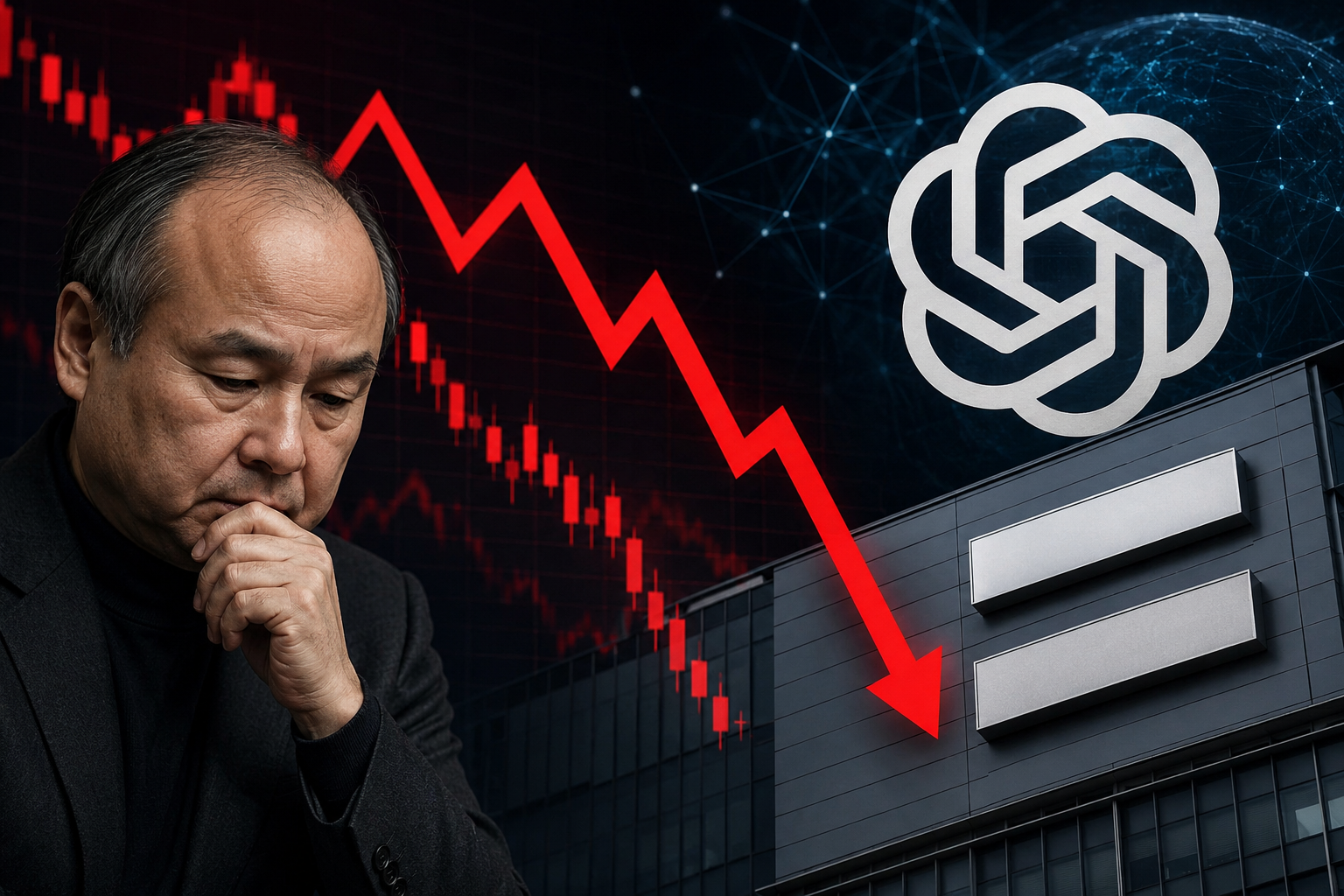
SoftBank Group saw a major fall in its share price after reports said OpenAI may delay its expected public stock market launch. The Japanese investment giant faced heavy selling pressure as investors reacted to fresh uncertainty around one of the world’s biggest artificial intelligence companies.
The report created concern in the market because SoftBank has become one of OpenAI’s largest financial supporters. Many investors had expected OpenAI to go public soon, which could have brought huge returns for SoftBank. But now, with reports of a delay, confidence has weakened and traders have started to rethink the future value of SoftBank’s investment.
The sudden reaction clearly showed how strongly market sentiment now depends on the fast-growing artificial intelligence sector.
Sharp Fall In SoftBank Stock Price
After news of the possible delay came out, SoftBank shares dropped between 12% and 14% during trading in Tokyo. This sharp fall erased a large amount of market value in a very short time.
Investors had pushed SoftBank shares higher over recent months because of growing excitement around artificial intelligence. Much of that optimism came from SoftBank’s close connection with OpenAI.
The company had become one of the biggest names linked to the global AI boom. Because of that, any negative news around OpenAI now has a direct effect on SoftBank’s stock performance.
This latest drop proved how sensitive investors remain when expectations around AI companies suddenly change.
Why OpenAI May Delay Its IPO
Reports suggested that OpenAI may delay its stock market debut until 2027, or at least much later than earlier expectations.
There are several reasons behind this possible decision.
One reason is the unstable condition of global technology markets. Big technology companies have faced market pressure over the last few months, which makes a large IPO riskier.
Another reason comes from weak performance seen in several recent tech listings. Some large companies that entered the stock market recently failed to perform as investors had hoped.
OpenAI may also want to avoid market pressure that often comes after public listing. Public companies face constant investor scrutiny, quarterly earnings pressure, and strong demands for immediate financial results.
Because of these factors, company advisers may prefer to wait for a better market environment.
SoftBank Has Massive Exposure To OpenAI
The reason behind the strong reaction in SoftBank shares is simple. The company has placed a huge bet on OpenAI.
Reports estimate that SoftBank has committed nearly $65 billion toward OpenAI by October 2026. This makes it one of the company’s biggest financial supporters.
Investors believed that once OpenAI entered the stock market, SoftBank would gain enormous paper profits from this investment.
A successful IPO would also make OpenAI’s market value public, which could help investors better understand the true value inside SoftBank’s large investment portfolio.
Because of these expectations, many traders saw OpenAI as one of SoftBank’s biggest future growth drivers.
Now that timeline has become uncertain.
Why Investors Became Nervous
When a company like SoftBank invests heavily in a private company, investors often wait for an event that turns that investment into real value.
An IPO usually creates that opportunity.
If OpenAI delays its public listing, SoftBank may need to wait much longer before investors can clearly see returns from its huge investment.
This means delayed liquidity. It also means delayed profits on paper.
Another important factor is what experts call the “conglomerate discount.”
SoftBank owns many different companies and investments. Investors sometimes struggle to calculate the exact value of these holdings. Because of this confusion, markets often value SoftBank below the total worth of its assets.
An OpenAI IPO could have reduced that discount.
Now investors may need to wait much longer.
AI Stocks Also Face Pressure
The market reaction did not stop with SoftBank.
Other companies connected with artificial intelligence also saw weakness after the report came out.
Oracle shares moved lower during premarket trading in the United States. Investors also sold shares of CoreWeave, a company closely connected to AI infrastructure and OpenAI-related services.
In Japan, several semiconductor and technology companies tied to the AI supply chain also faced selling pressure.
The wider market reaction showed that investors now watch artificial intelligence companies very closely.
Any sign of weakness in major AI companies quickly spreads across the sector.
Bigger Question Around AI Valuations
This event has created a bigger question in the financial world.
Many investors now wonder if artificial intelligence company valuations have moved too high too quickly.
Over the last two years, AI companies have attracted huge amounts of capital. Investors have rushed to place money into anything connected to artificial intelligence.
This excitement pushed company valuations sharply higher.
But some market experts now ask whether actual profits can justify these extremely high numbers.
The SoftBank selloff reflects these concerns.
Investors may now begin to question whether AI stocks deserve such premium valuations.
OpenAI May Wait For Bigger Opportunity
The IPO delay does not necessarily mean trouble inside OpenAI.
In fact, the company may simply want better timing.
Reports suggest OpenAI may target an enormous valuation close to $1 trillion in the future.
If market conditions improve later, the company could achieve a much higher value than what is possible today.
OpenAI may also want more time to grow revenue and strengthen its business before entering public markets.
Staying private allows the company to focus on expansion without pressure from public shareholders.
This strategy may help the company build a stronger financial foundation.
What Investors Will Watch Next
The next few weeks may become important for both SoftBank and the wider AI market.
Investors now want official clarity from OpenAI regarding its IPO timeline.
Markets will also watch whether SoftBank founder Masayoshi Son changes his artificial intelligence investment strategy after this sudden stock decline.
Another important area of focus is the Stargate project, a major AI infrastructure effort linked with future AI growth plans.
If spending slows there, market concerns may increase further.
For now, analysts believe this situation reflects short-term valuation concerns rather than weakness in artificial intelligence itself.
The AI industry still shows strong long-term growth potential.
However, this event serves as a reminder that market excitement alone cannot support valuations forever.
For SoftBank investors, the message has become very clear.
The future opportunity still exists, but the wait may now become much longer.
ALSO READ: Apple Raises Mac and iPad Prices Due to Chip Shortage