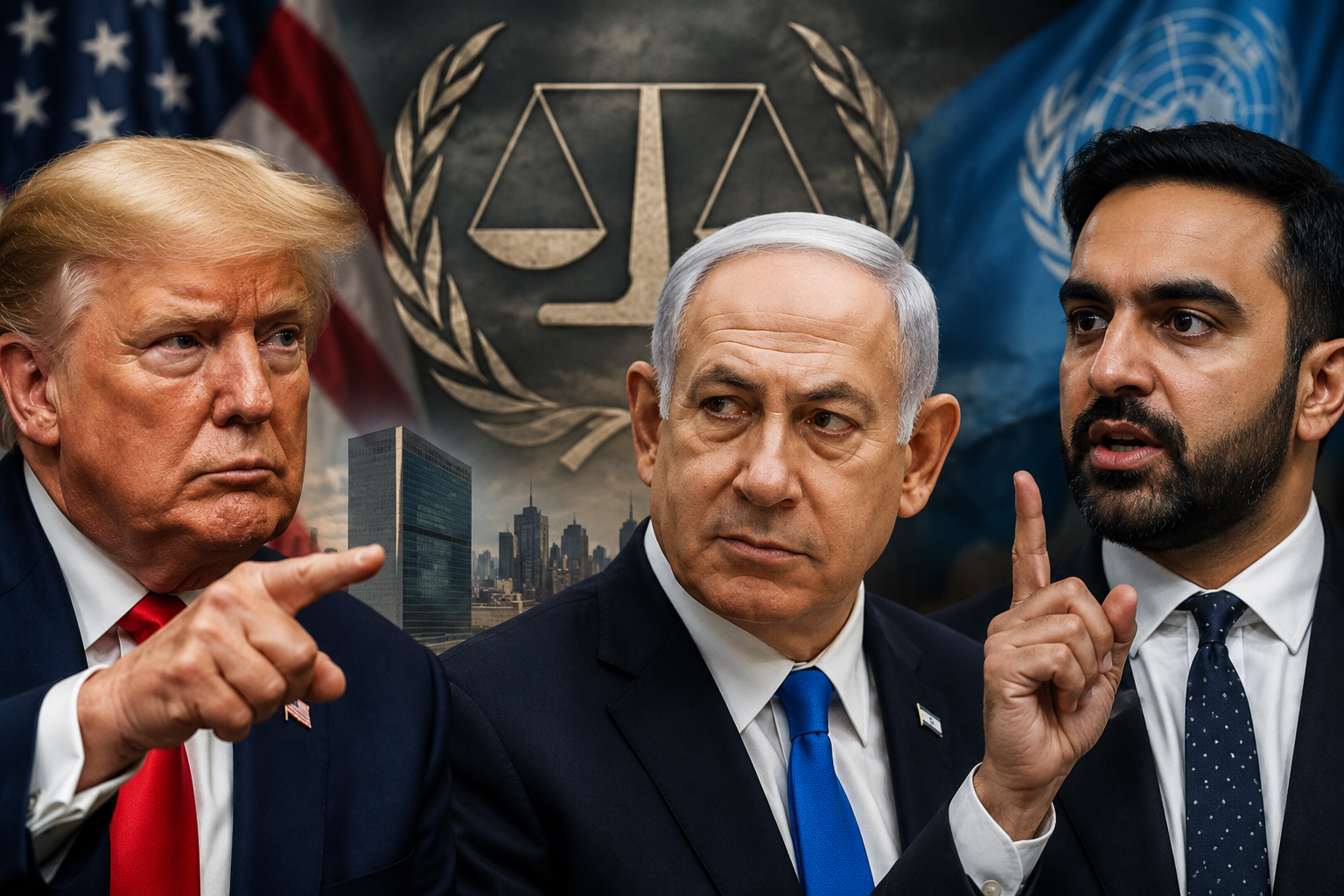
A fresh political and legal debate has started in the United States after President Donald Trump said that Israeli Prime Minister Benjamin Netanyahu will not face arrest if he visits the country. His statement came after New York City Mayor Zohran Mamdani spoke about the arrest warrant that the International Criminal Court (ICC) issued against Netanyahu. The issue has attracted attention across the world because it involves international law, US policy, and the long-running conflict in the Middle East.
Trump made his position very clear. He said that Netanyahu would not face arrest during a visit to the United States. His remarks came as people discussed whether the ICC warrant could have any effect if the Israeli leader travels to New York for the United Nations General Assembly later this year.
Trump Rejects the Possibility of an Arrest
President Donald Trump said that Netanyahu will not face arrest in the United States. He did not explain his statement with a detailed legal argument, but his message left little room for doubt. Trump made it clear that his administration would not allow such an action to happen.
His comments came after reports that New York City Mayor Zohran Mamdani had discussed whether there was any legal way to respond to the ICC arrest warrant if Netanyahu visited the city. Trump strongly opposed that idea and dismissed the possibility that Netanyahu could face legal action while on American soil.
The statement quickly became an important political issue because it touched on US foreign policy and relations with Israel, one of America’s closest allies.
Mamdani Supports the ICC Position
Zohran Mamdani has taken a different view on the matter. He has defended the ICC warrant and said that leaders should face accountability if international courts accuse them of serious crimes.
Mamdani said he wanted to examine whether New York City had any authority to act if Netanyahu entered the city. His comments led to a wider discussion about the role of local governments when international legal issues become part of public debate.
His position has received support from people who believe international courts should have a stronger role in cases that involve war crimes. Others have argued that local officials cannot make decisions that belong to the federal government.
Why the ICC Issued the Warrant
The International Criminal Court issued an arrest warrant for Benjamin Netanyahu in 2024. The court accused him of war crimes linked to the conflict in Gaza.
Israel has strongly rejected those accusations. The Israeli government says that the ICC does not have legal authority over the country. Israeli leaders have also described the warrant as politically motivated and unfair.
The case has remained one of the most controversial decisions made by the ICC in recent years. It has created sharp differences between countries that support the court and those that reject its authority.
The United States Does Not Recognize ICC Authority
One of the biggest reasons behind this debate is the position of the United States on the International Criminal Court.
The United States is not a member of the ICC. Because of that, the country does not accept a legal duty to enforce arrest warrants issued by the court. This has remained official US policy for many years under different administrations.
As a result, legal experts believe that an ICC warrant does not automatically lead to an arrest inside the United States. Federal authorities would have to decide how to respond, and American law does not require them to carry out such warrants.
This legal position plays a major role in Trump’s confidence that Netanyahu will not face arrest during a visit.
Questions Over New York City’s Authority
Another important issue is whether New York City has any legal power to arrest a foreign leader because of an ICC warrant.
Many legal experts believe the answer is no. They argue that foreign policy and relations with other countries belong to the federal government, not to city governments.
A mayor can speak about international issues and express support for certain policies. However, experts say a local government cannot simply enforce an ICC arrest warrant against a visiting foreign leader, especially when federal policy takes a different position.
Because of this, many observers believe that Mamdani’s comments are more political than practical.
Netanyahu May Visit New York
The debate has become even more important because Benjamin Netanyahu is expected to travel to New York for the United Nations General Assembly later this year.
World leaders from many countries attend the annual meeting at the United Nations. Security and diplomatic arrangements usually involve close cooperation between US federal agencies and local authorities.
If Netanyahu attends the meeting, the discussion around the ICC warrant will likely return to the headlines. Even so, many legal experts believe the chances of an actual arrest remain very low.
Different Views Across the World
The ICC warrant has divided governments across the globe.
Some countries support the court and believe its decisions should receive respect. They argue that international justice must apply equally to all leaders, no matter which country they represent.
Other nations question the court’s authority or disagree with its decisions. Israel remains one of those countries. The United States has also maintained its own independent position by staying outside the ICC system.
These differences have made the Netanyahu case a major topic in international diplomacy.
A Political Issue Inside America
The issue has also become part of American politics.
Trump has presented himself as a strong supporter of Israel throughout his political career. His latest statement continues that approach by offering public support to Netanyahu.
Mamdani has taken a different path by speaking in favor of the ICC process and the idea of international accountability. Their opposite views show how foreign policy issues can also become subjects of domestic political debate.
As public discussion grows, supporters of both sides continue to defend their positions with strong arguments.
Legal Experts See Major Obstacles
Law experts have pointed to several legal barriers that make an arrest unlikely.
The United States has no obligation to enforce ICC warrants because it is not a member of the court. In addition, local governments do not control American foreign policy. Experts also note that any attempt to arrest a visiting foreign leader would raise serious constitutional and diplomatic questions.
For these reasons, many specialists believe the legal path toward such an arrest would be extremely difficult.
The Debate Is Far From Over
Trump’s promise that Netanyahu will not face arrest has added a new chapter to an already complex international issue. At the same time, Mamdani’s support for the ICC warrant has kept public attention on questions about accountability and international law.
The debate now goes beyond one court decision. It has become a larger discussion about the balance between national sovereignty, international justice, and the limits of local government authority.
As Netanyahu prepares for possible international travel, including a visit to New York for the United Nations General Assembly, this issue will likely remain in the spotlight. While legal experts continue to say that an arrest in the United States is highly unlikely, the political arguments surrounding the case are expected to continue for months ahead.