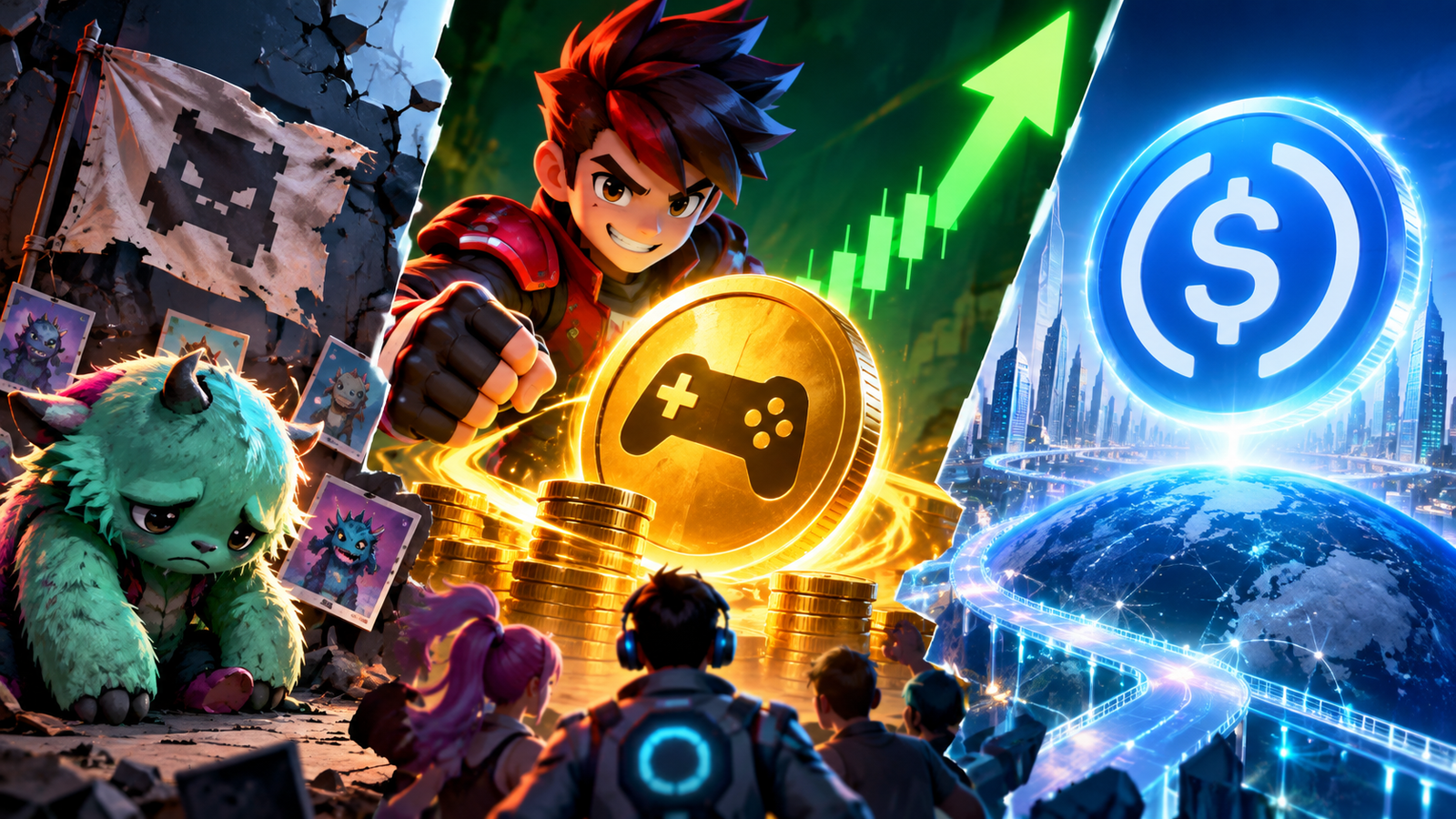
September 16, 2026 has produced a mixed set of developments across crypto gaming and blockchain infrastructure. The most notable direct gaming story is the decision by Pixelmon to end its game development work. At the same time, the wider GameFi market has shown a sharp rise despite weakness across much of the wider crypto market. Akedo, with its AKE token, has been the main source of that GameFi move.
A separate but relevant development is the public launch of Circle’s Arc mainnet. Arc is not a crypto game, and it should not be described as one. Its relevance to Web3 games comes from its focus on stablecoin-based payments, low and predictable transaction costs, and blockchain infrastructure that developers may use for financial functions.
There is an important point about the date. Several crypto gaming stories that appeared in recent news feeds were first published on September 14 or September 15. They should not be presented as September 16 news. For that reason, this report does not add older Axie, Cambria, Otherside, Big Time or Craft World reports simply to create a longer list.
Pixelmon ends game development
The clearest crypto gaming story for September 16 concerns Pixelmon. The project has ended all game development and has cut its game team. The decision came after an external publisher conducted a test for about three weeks. According to reports based on Pixelmon’s official Discord announcement, the test did not produce a long-term commercial offer.
The external publisher used its own marketing budget and tools to assess the games. The stated purpose was to examine factors such as player acquisition and player retention. Pixelmon did not say that the games were rejected in a simple yes-or-no manner. Instead, the test results were not strong enough to support a longer commercial deal.
The publisher reportedly offered a further route. Pixelmon could make additional changes and conduct another test within a few weeks. The management team chose not to take that route. The project had already spent more than two years in what its own statement described as a level that was not sufficiently strong for a sustainable game business.
This distinction matters. The available reports do not say that Pixelmon has disappeared as a brand. They say that its game development operation has ended. A smaller core team is expected to remain and explore business models outside traditional game development. Further details were due through a community town hall.
The existing games are also expected to go offline, with related systems set for removal. Pixelmon has said that refunds are not an option under its current corporate and shareholder structure. The remaining funds are intended to support a new attempt to find a viable business model. If that effort does not work, reports state that the company could face closure.
What the Pixelmon decision tells us
The Pixelmon case gives a useful view of one problem within Web3 games. A project can have an established NFT collection, a recognised brand, a token, past funding and a large online community, but those factors do not by themselves prove that a game has a sustainable commercial model.
The external publisher test is important because it placed attention on ordinary game-business measures. Player acquisition and player retention matter to publishers because a game needs users who return after the first session. A strong NFT community may help with an initial audience, but it does not automatically create long-term game demand.
It would be too strong to say that Pixelmon failed because of one single factor. The available information does not provide enough detail about every part of the business. It does, however, show that the publisher test did not produce terms that Pixelmon management considered strong enough for further investment.
Pixelmon also has a notable history within the NFT sector. The project began in 2021 with plans for an open-world RPG, NFT characters, virtual land and play-to-earn features. Its February 2022 Genesis NFT sale used a Dutch auction that started at 3 ETH per NFT and reportedly raised about $70 million.
The project later faced major criticism after its artwork reveal did not match what many buyers expected from earlier promotional material. A green character known as Kevin became widely associated with the controversy and later became a major part of Pixelmon’s identity.
The project then went through a change of leadership and a broader effort to rebuild the brand. In 2023, Pixelmon released Kevin the Adventurer on Base. Reports said the game reached about 36,000 players at launch. PixelPals followed, along with plans for additional titles. In 2024, the team raised another $8 million, with Animoca Brands among the participants.
The figures need careful context. The roughly $70 million figure relates to the earlier Genesis NFT sale and should not automatically be described as money raised by the current game team. BlockchainGamerBiz specifically notes that the later team should be treated separately from the original NFT sale. The 2024 team later raised $8 million, while the broader MON token and publishing effort involved separate capital flows.
For NFT or token holders, the immediate issue is therefore not only market value. The more important questions concern the future use of the Pixelmon IP, the status of the existing NFT collections, the future of MON, and whether any community or third-party structure may take control of parts of the ecosystem.
No conclusion about the future value of Pixelmon NFTs or MON should be drawn from the game shutdown alone. A project can change its business model without making an asset worthless, while an asset can also lose utility even if its blockchain record remains intact.
GameFi rises while the wider crypto market falls
The second major September 16 story comes from the GameFi market itself. KuCoin reported that GameFi rose 9.65% over 24 hours while the wider crypto market faced a decline. The same report stated that Bitcoin traded below $75,000 and Ethereum fell below $2,400 during the period covered.
The contrast is notable because GameFi did not move in the same direction as several large crypto sectors on that date. KuCoin reported a 3.17% decline for Bitcoin and a 4.88% decline for Ethereum in the cited period. PayFi fell 8.44%, while the GameFi sector posted its 9.65% gain.
These figures describe a short market window. They should not be read as proof that GameFi has entered a long-term recovery. Crypto sector performance can change rapidly, and a 24-hour move does not establish a durable trend.
The GameFi result was nevertheless notable because it showed relative strength at a time when several other crypto categories were under pressure.
Akedo becomes the main GameFi market story
Within that GameFi move, Akedo’s AKE token was the most visible name in the data cited by KuCoin. The report stated that AKE rose 76.22% during the same 24-hour period.
Other market data also showed a large AKE move on September 16. CoinLore reported AKE at about $0.0271, with a 71.42% rise over 24 hours at the time of its update. It also reported more than 2.26 billion AKE in 24-hour volume, with the value of that volume at about $61.45 million.
Another market source showed AKE near $0.0276, with a gain of about 65.15% at its stated update time.
The difference between these figures is not necessarily a contradiction. Crypto prices and percentage changes can vary by exchange, data source and exact time of measurement. The safest statement is that AKE recorded a very large one-day rise on September 16, with several sources placing the gain between roughly 65% and 76%.
Why the AKE move needs caution
A sharp token move does not by itself establish a change in the underlying game business. Price action can result from many factors, such as trading volume, liquidity, exchange activity, market sentiment, new demand or short-term speculation.
There is also a difference between the performance of a token and the performance of a game. A token can rise while a game’s user base stays unchanged. The reverse can also happen.
For this reason, AKE’s September 16 move is best described as a market event rather than proof of a fundamental improvement in the Akedo game ecosystem.
The same principle applies to the wider 9.65% GameFi rise. The figure is useful because it shows what happened during the reported period. It does not establish what will happen next.
Circle Arc mainnet goes public
Another major blockchain event on September 16 is the public launch of Circle’s Arc mainnet. Circle had announced the September 16 launch in August, and its official Arc materials confirm the date.
Arc is an open Layer 1 blockchain designed around financial use cases. Its stated focus includes stablecoin payments, real-time money movement, foreign exchange, tokenised assets and other financial applications. Circle has described Arc as an economic infrastructure layer rather than a gaming network.
The gaming connection is indirect. Web3 games often need systems for payments, digital assets, transactions and other economic functions. A network with stablecoin-native infrastructure could therefore be relevant to future games that choose to use it.
Arc uses USDC as its native gas token, according to Arc’s published material. The network also targets sub-second transaction finality. These features may reduce some of the user-experience problems that can arise when players must hold a separate volatile token simply to pay transaction fees.
That does not mean Arc will become a major gaming chain. There is no basis on September 16 to make that claim. Its stated launch focus is much broader and centres on financial infrastructure.
The launch does, however, show how the blockchain sector continues to move toward systems where stablecoins can serve as a direct part of the transaction experience.
The main numbers from September 16
| Development | September 16 data | Context |
|---|---|---|
| GameFi sector | +9.65% | 24-hour move reported by KuCoin |
| Akedo AKE | +76.22% | 24-hour move reported by KuCoin |
| AKE, CoinLore | +71.42% | Separate market-data update |
| AKE, RSI Hunter | +65.15% | Separate market-data update |
| Bitcoin | Below $75,000 | Price level cited in KuCoin report |
| Ethereum | Below $2,400 | Price level cited in KuCoin report |
| Pixelmon | Game development ended | Decision followed an external publisher test |
| Pixelmon publisher test | About 3 weeks | Test focused on acquisition and retention |
| Pixelmon 2024 funding | $8 million | Later funding round after the earlier NFT era |
| Pixelmon Genesis sale | About $70 million | Earlier 2022 NFT sale |
| Arc | Public mainnet on Sept. 16 | Circle’s financial infrastructure network |
The table shows why these events should not be treated as one single market story. Pixelmon concerns a business decision. AKE concerns token-market activity. GameFi’s 9.65% figure concerns a sector index or group of assets. Arc concerns blockchain infrastructure.
What matters for the crypto gaming sector
The September 16 data suggests that crypto gaming remains a sector with very different outcomes among individual projects.
Pixelmon’s decision shows the difficulty of turning a known NFT brand into a sustainable game business. The external publisher test placed attention on player acquisition and retention rather than only on token activity or NFT ownership. That is a useful commercial distinction for the sector.
At the same time, the GameFi market posted a strong one-day rise. AKE’s large move shows that investor and trader interest can remain active even when parts of the wider crypto market fall.
These two facts can exist at the same time. A sector can have strong token-market activity while individual game companies face serious business problems. Token performance and game performance are related in some projects, but they are not identical.
Arc adds another layer to the picture. Blockchain infrastructure continues to develop toward faster transactions and stablecoin-based payments. For game developers, this may create new technical options. It does not guarantee adoption by game studios or players.
A careful view of the day
The safest reading of September 16 is therefore not that crypto gaming is either back or finished. The available data supports a more limited conclusion.
Pixelmon has ended its game development effort after an external publisher test did not produce a long-term commercial offer. GameFi, as reported by KuCoin, rose 9.65% over 24 hours. AKE recorded a particularly large rise, with different market sources reporting gains from about 65% to 76% depending on the time and source. Circle’s Arc mainnet also reached its public launch date, although Arc is blockchain financial infrastructure rather than a game.
These facts show a sector with both positive market activity and difficult business outcomes.
For readers, the key distinction is between reported events and future expectations. The September 16 figures describe what happened during specific periods. They do not establish future token prices, future game success or future investment returns.
Pixelmon’s next phase also remains uncertain. The project has indicated that a smaller team will explore non-gaming business options, but the available information does not establish which model will succeed. The future status of its games, NFTs, MON and IP therefore requires further official updates.
The same caution applies to AKE. A one-day gain of 76.22% is a historical market figure, not a statement about future performance. Market data can change quickly, and different exchanges can show different prices and percentage changes.
Arc should also be viewed within its stated purpose. Its September 16 launch creates another blockchain infrastructure option, but there is not enough evidence on this date to say that it will become a major platform for crypto games.
Final view
September 16, 2026 offers a useful snapshot of the current Web3 gaming market. Pixelmon provides the clearest example of the commercial pressure faced by game projects that need sustained player activity and publisher support. GameFi’s 9.65% rise shows that token-market interest can remain strong even during a broader crypto decline. AKE’s sharp move adds a clear example of the volatility that can exist inside the sector. Arc’s mainnet launch shows that the wider blockchain infrastructure around digital payments and assets continues to develop.
Taken together, these events do not support a simple claim that crypto gaming is either expanding rapidly or losing relevance. The evidence points to a more complex market. Some assets can see strong short-term demand while individual game businesses reduce their operations. At the same time, new blockchain infrastructure can create additional technical choices for future applications.
For September 16 alone, the most important fact may be this separation between game business health, token-market performance and blockchain infrastructure. Each area has its own data, risks and timeline. Treating them as the same thing can create an inaccurate picture of the sector.
All figures and events above refer to the specific dates and reporting windows stated by the cited sources. Market figures are time-sensitive and may differ across exchanges or later updates. Nothing in this report should be read as a promise, forecast or recommendation about the future value of any token, NFT, company or game.
ALSO READ: Fed Decision, Intel Shock & Nvidia: US Stocks on Edge