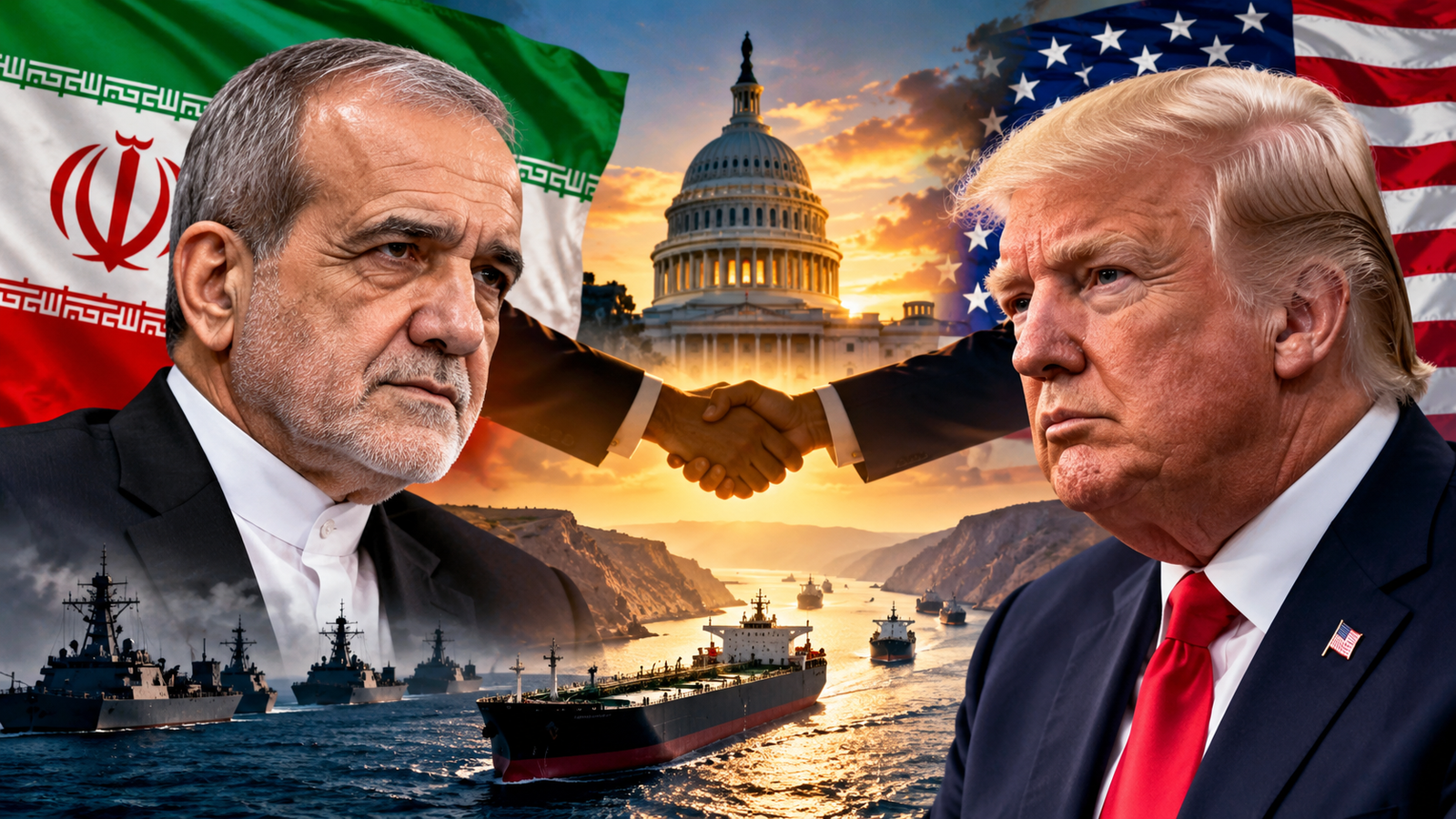
Iranian President Masoud Pezeshkian has said Tehran wants the United States to return to a ceasefire memorandum before the US midterm elections on 3 November 2026. His remarks came in New York during the United Nations General Assembly. The statement gives the diplomatic process a clear political deadline, although it does not by itself create a new ceasefire or guarantee a deal.
Pezeshkian said Iran does not want the dispute to continue until the midterm vote. He referred to the June memorandum of understanding, or MOU, which had set a temporary ceasefire framework before the arrangement later broke down.
Iran’s position, as described by Pezeshkian, is that Washington should return to that framework and that Tehran would then respond. Iran had made a similar offer earlier in September, when Pezeshkian said Tehran would reciprocate if the United States returned to its commitments under the MOU.
This distinction matters. The latest statement is a political and diplomatic signal, not proof that the two governments have agreed on the terms of a new ceasefire. A working agreement would require both sides to settle the details, establish a sequence of actions and create some way to verify compliance.
The June MOU remains central
The June MOU is now an important reference point in the diplomatic discussion. It is described as a temporary ceasefire arrangement that later collapsed. The current Iranian proposal seeks to bring the United States back to that earlier framework rather than start the diplomatic process from zero.
That approach may simplify the discussion in one sense. Both sides already have a previous document that can serve as a reference. At the same time, the collapse of that arrangement shows that agreement on paper may not be enough. The parties would still need to address the reasons the earlier framework failed and decide how future commitments would be carried out.
The legal and diplomatic meaning of the MOU also requires care. A memorandum of understanding is not automatically the same thing as a final peace treaty or a comprehensive settlement. Its exact legal effect depends on its wording and on what the parties agreed about implementation.
For that reason, it is safer to describe the current development as an attempt to revive a previous ceasefire framework, rather than as the restoration of peace.
A direct difference over the election timeline
The latest Iranian position also creates a clear difference between Tehran’s public message and statements from President Donald Trump.
Pezeshkian says Iran wants an agreement before the November midterms. Trump has publicly said that he expects a possible agreement after the elections. At the United Nations, Trump again suggested that the conflict could end after the midterms, while also saying that a deal remained possible.
The two positions therefore differ not only on substance but also on timing.
| Issue | Iranian position | US position publicly reported |
|---|---|---|
| Timing | Tehran wants a return to the MOU before the midterms | Trump has said a deal may come after the midterms |
| Ceasefire | Iran wants the June framework revived | Washington has not publicly accepted Tehran’s proposed return |
| Nuclear issue | Pezeshkian said Iran is open to nuclear inspections | Nuclear oversight remains an important US concern |
| Strait of Hormuz | Iran has linked reopening to broader US concessions | Washington has demanded concrete Iranian steps |
| Blockade | Iran seeks an end to the US blockade | Trump has not agreed to lift it before sufficient Iranian action |
| Current status | Proposal and diplomatic signal | No final settlement reported |
These positions should not be treated as fixed final negotiating terms. Governments often use public statements to set out positions while private talks continue through intermediaries.
Nuclear inspections could become a key issue
One of the more important parts of Pezeshkian’s statement concerns Iran’s nuclear facilities. He said Iran is open to inspections. Nuclear oversight remains one of the central issues in the US-Iran dispute.
This statement is potentially important because inspections can provide a mechanism for outside verification. However, the word “open” does not establish what inspections would cover, who would conduct them, how often they would take place or what access would be permitted.
Those details could become central to any formal agreement.
A workable nuclear arrangement would need clear rules on access, verification, reporting and consequences for alleged violations. Without such details, a general statement of willingness does not tell us how far the two sides have actually moved.
It is therefore useful to separate the political signal from the technical question. The political signal is that Tehran is publicly presenting nuclear inspections as something it can discuss. The technical question is whether Iran and the United States can agree on a verification system that both sides accept.
The Strait of Hormuz adds another layer
The Strait of Hormuz is another major part of the diplomatic picture.
According to reports, a senior Iranian official said Iran was prepared to reopen the strategically important waterway within about a week if the United States reduced military pressure and lifted its blockade of Iranian ports.
Iran had also sent a proposal to the United States through mediators on 16 September.
This creates a possible sequence for negotiations.
Iran could seek relief from the US blockade and reduced military pressure. In return, Tehran could provide steps related to the Strait of Hormuz. The exact sequence remains subject to negotiation.
Reports have described an Iranian proposal that included a region-wide ceasefire of up to 60 days, a phased reopening of the Strait of Hormuz and an end to the US blockade.
There have also been reports of talks through mediators that include Qatar, Pakistan and Egypt.
These reports suggest that the diplomatic discussion may now cover more than a simple bilateral ceasefire.
Why Hormuz matters beyond Iran and the US
The Strait of Hormuz has importance far beyond the two governments.
A prolonged disruption can affect oil supply, shipping costs, insurance rates and energy prices. Reports showed that oil prices had already reacted to uncertainty over the conflict and to comments about the timing of a possible agreement.
On 22 September, Brent crude was near $99.94 per barrel, while WTI was around $95.43 at the time reported.
These figures are historical observations from that trading session, not a current price forecast.
A credible reduction in the risk around Hormuz could reduce part of the geopolitical risk premium in energy markets. The reverse is also possible if talks fail or military pressure rises.
That does not mean every diplomatic headline will produce a lasting oil-price move. Markets usually place greater weight on concrete actions than on statements alone.
The important point is that Hormuz gives the negotiations an immediate economic dimension.
The possible diplomatic sequence
Reports now point to a possible phased process rather than one large agreement that resolves every dispute at once.
A broad outline could involve a ceasefire, steps on the blockade, action related to Hormuz, nuclear verification and then wider negotiations. The precise order remains unsettled.
| Possible stage | Main issue | What would need clear agreement |
|---|---|---|
| First | Military de-escalation | Which attacks stop and when |
| Second | US blockade | What restrictions are removed and under what conditions |
| Third | Strait of Hormuz | What steps Iran takes to restore normal passage |
| Fourth | Nuclear inspections | Scope, access and verification rules |
| Fifth | Wider settlement | Sanctions, security concerns and longer-term relations |
This table describes the issues reported in the current diplomatic discussion. It does not represent an agreed settlement.
The value of a phased approach is that each side could receive a measurable step before the next stage. The difficulty is that each step can also become a point of disagreement.
The election creates a fixed political deadline
The date of the US midterm elections is 3 November 2026. That gives the diplomatic process a much shorter window than a normal long-term negotiation.
Pezeshkian has placed the deadline directly into his public proposal. Trump, however, has spoken about an agreement after the election.
That difference could matter because negotiations require time for technical work. Even if the political leaders agree on the broad direction, officials would still need to settle difficult details.
There is also an important legal and institutional point. A political statement by a president does not automatically bind every institution or future administration to a permanent settlement. The durability of any agreement would depend on its legal form, domestic procedures, implementation rules and the willingness of the parties to comply.
For this reason, the election deadline should be viewed as a political time marker, not as a legal deadline for the conflict.
The role of intermediaries
The latest reports also show the importance of third countries.
Iran has sent proposals through mediators. Reports have also described contacts involving Qatar, Pakistan and Egypt.
Intermediaries can help when direct communication is difficult. They can carry messages, test possible compromises and help the parties discuss sensitive issues without requiring a public meeting between senior leaders.
That does not mean that the mediators control the process. The United States and Iran would still have to accept the final terms.
The reported role of several countries also shows that the conflict has regional consequences. Any arrangement that concerns Hormuz, attacks on neighbouring states or regional security could require wider consultation.
What has actually changed
The latest development is important because Iran has again placed a concrete diplomatic option in public view.
There are several parts to the signal. Pezeshkian wants the June framework back before the midterms. He has said Iran is open to inspections of its nuclear facilities. Iran has also put forward ideas that connect a ceasefire with Hormuz and the US blockade.
At the same time, there is no evidence of a completed new ceasefire agreement.
That distinction is especially important for financial markets and businesses. A statement can change expectations very quickly, while implementation can take much longer.
The most useful evidence in the next stage will therefore come from actions.
What would show real progress
Several developments would provide clearer evidence of movement.
A formal written agreement would matter more than a public statement. A confirmed halt in attacks would provide stronger evidence than a promise to seek one. Actual movement through the Strait of Hormuz would matter more than a statement that reopening is possible.
Similarly, confirmed nuclear inspections would provide more information than a general statement that Iran is open to inspections.
A reduction or removal of the US blockade would also be a concrete step. If such actions occur in a coordinated sequence, the risk of a simple reversal could be lower than if the process remains based mainly on public declarations.
None of these events alone would guarantee a permanent settlement. They would, however, provide more measurable evidence of progress.
The central issue is trust and verification
The largest problem may not be finding a broad political formula. It may be finding a formula that both sides believe the other side will follow.
The collapse of the June ceasefire framework is relevant here. Any new arrangement would need clearer procedures for compliance and for disputes over alleged violations.
This is where verification becomes important.
For nuclear matters, inspections could provide outside evidence. For military issues, monitoring could help establish whether attacks have stopped. For Hormuz, shipping movements could offer a visible test of whether access has returned.
A detailed agreement could therefore reduce uncertainty by replacing broad promises with specific actions and verification rules.
Market impact remains conditional
Oil and shipping markets are likely to remain sensitive to each new development.
Reports showed that oil prices rose after Trump’s comments that a peace deal might come after the US elections. Higher fuel prices and supply concerns were already affecting markets.
A successful diplomatic process could reduce concerns about supply disruption. But it would be premature to assume that one statement from Tehran will produce a lasting change in oil prices.
The market question is simple: will words turn into barrels, shipping access and lower military risk?
Until there is evidence of that transition, price reactions may remain volatile.
What happens before 3 November
The next phase is likely to focus on whether the public proposals can become a structured negotiation.
Iran wants the June framework back before the midterms. The United States has publicly discussed a different timeline. The two sides also face difficult questions about Hormuz, the blockade, nuclear inspections and regional security.
There is therefore a diplomatic opening, but several conditions still need resolution.
The safest interpretation of the current information is that Iran has made a fresh public proposal for an earlier diplomatic settlement, while Washington has not publicly accepted the full Iranian position.
The coming weeks should show whether the June MOU can serve as a real basis for talks or only as a reference point in public diplomacy.
For now, the most significant fact is not that a ceasefire has returned. It is that both sides are discussing a possible route back to negotiations while disagreeing over the timing, sequence and conditions.
That makes the period before 3 November 2026 an important diplomatic window. Whether that window produces a renewed ceasefire will depend on written terms, reciprocal action and verification rather than statements alone.