
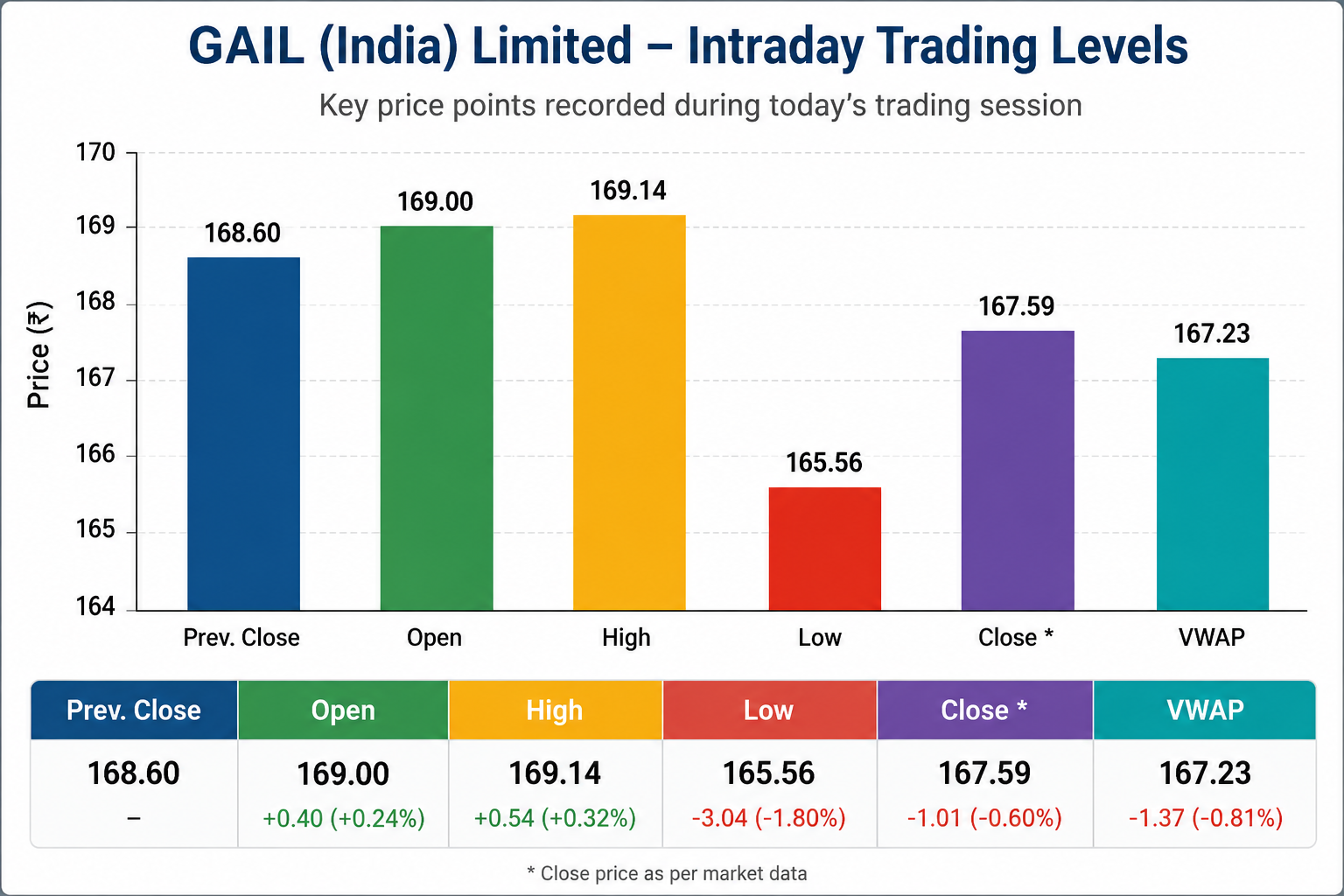
GAIL (India) Limited ended Tuesday’s session on a softer note as cautious sentiment stayed visible across the gas and energy space. The stock opened at ₹169.00 and touched an intraday high of ₹169.14. However, selling pressure emerged during the day and pushed the stock toward a low of ₹165.56. The counter later recovered part of the losses and settled at ₹167.59 against the previous close of ₹168.60.
The volume-weighted average price, also known as VWAP, stood at ₹167.23. The final close remained below the opening level, which reflected a lack of strong buying support during market hours. The overall move stayed moderate, yet traders closely watched the stock because the broader energy segment showed signs of caution.
Market Mood Around Gas Stocks Stayed Weak
The natural gas segment saw a soft undertone during the session. Several gas-linked counters traded under pressure as investors remained careful about near-term earnings visibility. GAIL often reacts to changes in the wider gas distribution and LNG market because a large part of its business depends on transportation, trading, and supply of natural gas.
Recent market discussions around gas demand, pricing pressure, and LNG availability kept investor confidence limited. Even though no major negative company-specific announcement surfaced during the day, the sector itself lacked strong positive triggers.
This kind of movement usually reflects caution rather than panic. Market participants often reduce exposure in sectors where near-term growth visibility appears uncertain. GAIL also came under that broader sentiment.
LNG Pricing Concerns Continue To Influence Sentiment
Global LNG prices remain an important factor for companies linked to gas transportation and marketing. Higher LNG costs may affect margins across parts of the energy value chain. Investors therefore monitor international gas prices very closely while assessing companies such as GAIL.
Recent reports in the energy market pointed toward supply-side uncertainty in global LNG trade. Such conditions may influence import costs and profitability assumptions in future quarters. While there is no direct evidence that one specific event caused today’s decline, market participants appeared cautious about the broader pricing environment.
The market also tends to react quickly whenever traders expect pressure on transmission volumes or gas consumption growth. That cautious approach remained visible in today’s trade.
Investors Assess Future Growth Visibility
Another important area of focus remained GAIL’s future expansion outlook. The company continues to invest in pipeline infrastructure and related projects. Large capital expenditure plans often create mixed reactions in the market.
Some investors view expansion as a positive sign for long-term growth. Others prefer stronger near-term earnings visibility before increasing exposure. This difference in outlook sometimes creates short-term price pressure even when the long-term business outlook remains stable.
Analysts also continue to monitor progress in petrochemical operations and pipeline usage levels. Any slowdown in industrial gas demand may influence market expectations around revenue growth.
Profit Booking May Have Added Pressure
The stock had seen recovery from lower levels in earlier sessions. After such moves, traders often book profits near resistance zones. This pattern may have contributed to today’s decline.
The intraday structure showed that the stock failed to hold near the day’s high after opening. Sellers appeared active whenever the price moved closer to the upper range. However, the stock also recovered from the day’s low, which indicated that heavy panic selling did not emerge.
This type of session usually points toward cautious repositioning rather than aggressive bearish sentiment.
Broader Energy Space Remained Mixed
The wider energy market presented mixed signals during the day. Some oil-linked counters stayed relatively stable, while gas-focused stocks remained under pressure. This divergence highlighted the difference between crude-linked businesses and gas distribution companies.
GAIL’s movement therefore appeared more connected to gas sector sentiment rather than the broader benchmark trend. Investors continued to track developments linked to LNG imports, domestic gas demand, and policy-related expectations.
At the same time, market participants remained selective across PSU counters. Several state-owned companies witnessed rotational trades during the session as traders shifted exposure between sectors.
Price Data Reflects Controlled Weakness
The day’s trading range showed controlled volatility rather than extreme swings. The difference between the intraday high of ₹169.14 and low of ₹165.56 reflected moderate movement within a limited range.
The closing price of ₹167.59 remained slightly below both the previous close and opening price. That structure generally suggests cautious sentiment in the short term. However, the recovery from lower levels also showed that buyers remained active near support zones.
The VWAP level near ₹167.23 indicated that the stock traded close to its average session value before market close. Such positioning often reflects balanced activity between buyers and sellers.
ALSO READ: Utkal IPO Review With Financial Risk Analysis
Outlook Remains Dependent On Sector Triggers
Future movement in GAIL may continue to depend on broader gas sector developments, LNG pricing trends, transmission demand, and overall energy market sentiment. Investors are also likely to watch upcoming business updates, quarterly numbers, and policy-related developments linked to the natural gas ecosystem.
At present, today’s move appears linked more to sector caution and market positioning rather than any major company-specific disruption. The decline remained limited in nature and did not indicate any confirmed structural weakness in the company’s business model.
As always, short-term market movement may change quickly based on fresh developments, global energy trends, and investor sentiment.
GAIL Trades Near Important Technical Area
GAIL (India) Limited stayed in focus after the stock closed near an important technical zone on the daily chart. The counter ended at ₹168.60 and remained close to a major resistance area between ₹170 and ₹173. The latest chart structure showed a gradual recovery from the March 2026 low of ₹134.36. Since then, the stock has built higher levels with support from moving averages and improving momentum indicators.
The stock traded above key medium-term averages during the latest session. The 10-day moving average stood near ₹166.58, while the 20-day average stayed around ₹163.27. The 50-day average came near ₹164.93 and the 200-day average remained around ₹158.25. Price action above these levels usually reflects stable market sentiment in the near term.
The chart also showed that the stock faced resistance near ₹171.46 and ₹172.57. These levels matched important Fibonacci retracement zones. Traders usually track these areas because price often reacts sharply near such technical ranges.
Recovery From Earlier Weakness Looks Stable
The daily chart reflected a strong recovery after the sharp decline seen during the first quarter of 2026. The stock dropped close to ₹134 in March but later regained strength. Buyers returned near lower support levels and pushed the price higher over the past few months.
The latest price structure suggested that the market now views the ₹158 to ₹160 range as an important support zone. The stock also stayed above the Fibonacci 0.236 retracement level near ₹159.78. This area may continue to act as an important short-term base.
A move above ₹172.57 may improve sentiment further. If the stock sustains above that range, traders may shift focus toward ₹179.07 and ₹185.36. The chart also displayed a long-term projection near ₹206.26, though such targets depend heavily on market conditions, sector support, and broader sentiment.
At the same time, failure to hold above ₹164 may bring fresh caution into the counter. Market participants therefore may continue to watch price action near support zones very closely.
RSI Reflects Positive Momentum
The Relative Strength Index, also known as RSI, stood at 60.14. This reading reflected positive momentum without extreme overheating. Usually, RSI values above 50 support bullish sentiment, while readings near 70 suggest stronger speculative activity.
The RSI-based moving average came near 54.07. Since the RSI line stayed above its average, momentum remained favorable in the short term. However, the indicator still stayed below overbought territory, which suggested that the stock may still have room for movement if buying support continues.
Momentum indicators alone do not confirm future direction. Still, traders often use these readings to understand the strength behind recent price movement.
MACD Signals Moderate Strength
The MACD indicator also reflected improving sentiment. The histogram remained in positive territory near 0.30. This pattern generally points toward stable upward momentum. The MACD line also stayed above the signal line during the latest sessions.
Such setups usually support gradual strength rather than aggressive movement. However, indicators may change quickly if volume weakens or if the broader market turns negative.
The chart did not show panic-based activity. Instead, the structure reflected controlled participation from buyers near support zones.
Volume Activity Shows Active Participation
Trade data showed healthy market activity in the counter. Traded volume stood at 59.77 lakh shares, while traded value reached ₹99.95 crore. Volume near resistance zones often becomes important because it reflects conviction among market participants.
The stock also maintained a very low impact cost of 0.02. This metric generally reflects strong liquidity and ease of trade execution. The deliverable quantity ratio stood at 50.33%, which suggested balanced participation between short-term traders and positional investors.
The company’s total market capitalization remained at ₹1,10,211.82 crore. Free float market capitalization came near ₹45,087.21 crore. These figures highlighted GAIL’s strong position within the Indian gas transmission and marketing sector.
Long-Term Returns Present Mixed Picture
Return data showed mixed performance across different periods. The stock delivered a gain of 1.69% over one week. However, one-month performance remained slightly weak at -0.24%.
The year-to-date return stood at 0.68%, while the one-year return remained negative at -2.42%. This reflected the pressure seen across energy and gas-linked counters during the previous year.
Longer-duration numbers appeared stronger. The stock delivered 59.79% returns over three years and 54.82% returns over five years. These figures reflected the broader recovery in PSU and infrastructure-linked themes over the longer term.
Still, historical returns do not guarantee future performance. Market movement depends on several factors such as energy prices, gas demand, policy changes, and investor sentiment.
Valuation Stays Moderate Compared To Broader Market
The stock traded at a price-to-earnings ratio of 18.24. This level reflected moderate valuation compared with several other energy-sector names. Investors often compare valuation metrics alongside earnings visibility and future growth expectations.
The company also remained part of the NIFTY NEXT 50 index. Inclusion in major indices often supports institutional visibility and trading activity.
GAIL continues to operate in the gas transmission and marketing business, which remains closely linked to India’s long-term energy transition plans. Future growth expectations therefore depend partly on natural gas demand across industries, power generation, and city gas distribution.
Volatility Remains Within Controlled Range
The stock’s daily volatility stood at 1.81, while annualized volatility remained at 34.58. These numbers reflected controlled movement compared with several high-beta market counters.
The upper band stood near ₹184.34, while the lower band remained around ₹150.84. These levels reflected the broader permissible trading range based on exchange calculations.
The absence of a strict price band also reflected the stock’s liquid nature and large market capitalization.
Outlook Depends On Resistance Break
The current chart structure reflected cautious optimism rather than extreme bullishness. Price remained above important moving averages and momentum indicators stayed supportive. However, resistance near ₹172 to ₹173 continued to limit immediate upside.
A strong close above that range may improve confidence toward higher retracement levels near ₹179 and ₹185. On the downside, the ₹160 to ₹164 area may remain important for short-term support.
Overall, the chart reflected stable recovery after earlier weakness. The market now appears focused on whether the stock can sustain above key technical levels with support from stronger volume and broader sector sentiment.