
The derivatives market often gives early warning signs before volatility expands. One of the strongest signals traders watch closely is Market Wide Position Limit, commonly known as MWPL. This number shows how much total open interest exists in a stock relative to the exchange limit allowed for derivatives trading.
When a stock moves close to the upper limit, pressure builds inside the futures and options segment. At higher levels, exchanges may place restrictions under the F&O ban framework. This situation usually creates uncertainty because traders lose flexibility to open fresh derivative positions.
Latest derivatives data released ahead of tomorrow’s session now shows several stocks either already under restriction or moving close to critical MWPL levels. This makes the coming session important for traders who closely track short-term market structure.
One Stock Has Already Entered The F&O Ban List
Current exchange data confirms that Kaynes Technology India Ltd has already entered the F&O ban list.
A stock enters this category after total open interest crosses the exchange threshold set by market regulators. Once this happens, traders cannot create fresh futures or options positions. Only reduction of existing exposure remains allowed.
This restriction often changes trading behavior immediately. Participation usually falls, derivatives liquidity becomes weaker, and price movement may become less stable than normal sessions.
Such conditions often create sudden price swings because traders begin reducing leveraged positions.
ALSO READ: India Faces Economic Pressure From Oil, Forex, and Rain
MWPL Levels Are Moving Closer To Critical Zone
Apart from stocks already under restriction, exchange data shows several counters now move closer toward higher MWPL utilization levels.
The most important zone begins around 90 percent utilization.
Once stocks approach 95 percent MWPL, market participants begin paying closer attention because exchange restrictions may come quickly if fresh speculative activity pushes positions higher.
Below is a simple representation of the current pressure zone.
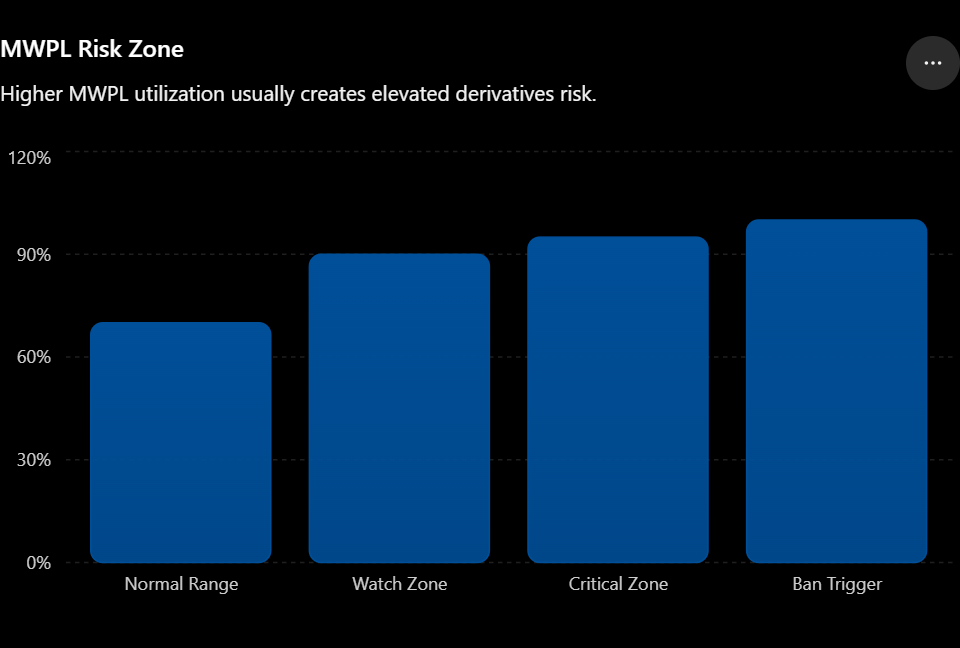
The chart clearly shows how exchange pressure rises sharply once utilization crosses the 90 percent mark.
Why Traders Closely Watch The 95 Percent Level
The 95 percent zone often attracts market attention because this level usually marks the final stage before exchange restrictions begin.
At this stage, market depth often changes quickly.
Liquidity generally becomes thinner because fewer participants feel comfortable creating fresh exposure. Bid and ask spreads may widen, making execution less efficient compared with normal sessions.
The futures market can also react sharply when large traders decide to reduce exposure suddenly. Because derivative positions carry leverage, even small price movement sometimes creates larger reactions than expected.
This explains why MWPL data often becomes an important signal for active derivatives traders.
Short Covering Can Create Unexpected Price Moves
Stocks near exchange limits sometimes experience another market event known as short covering pressure.
This usually happens when large bearish positions exist in futures contracts. If prices begin moving upward unexpectedly, traders who hold short positions may rush to exit.
This sudden demand can create rapid upward price movement over a short period.
Because open interest already sits near exchange limits, market participants often react faster than usual.
As a result, price action may become sharper compared with normal trading sessions.
This is one reason many experienced derivatives traders monitor MWPL data every day.
High Open Interest Creates Additional Risk
Open interest data becomes more important when combined with rising MWPL utilization.
When total open interest rises aggressively in a stock already close to exchange limits, it often suggests heavy speculative activity.
This situation does not automatically mean the stock will move higher or lower.
However, it often indicates crowded positioning.
Crowded positions can become unstable because a sudden change in market direction forces participants to exit simultaneously.
This usually increases volatility.
In simple terms, too many traders on one side of a trade often create unstable market conditions.
Tomorrow’s Session May See Higher Volatility In Select Counters
The latest derivatives numbers suggest tomorrow’s session deserves close observation.
Stocks already under restriction remain vulnerable to unusual price movement because fresh derivatives activity remains blocked.
At the same time, stocks that now approach higher MWPL utilization levels may face growing pressure if new positions continue rising during the next trading session.
This does not guarantee directional movement.
However, market structure suggests volatility may remain elevated compared with ordinary sessions.
Below is a simple market pressure comparison.
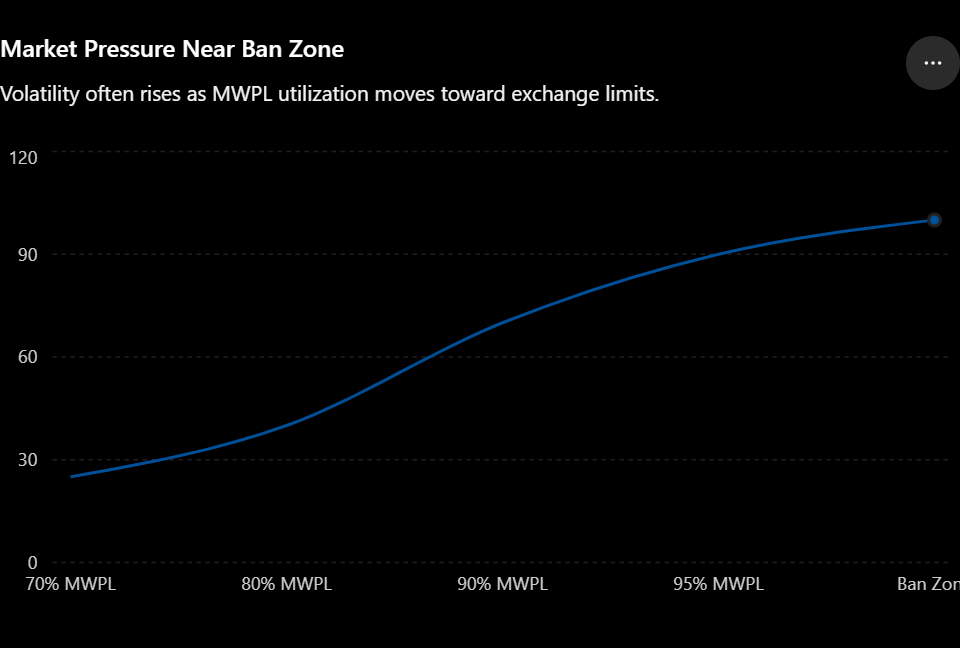
The relationship usually becomes stronger as stocks move closer toward the upper exchange threshold.
What Current Data Suggests
At present, Kaynes Technology India Ltd already sits inside the F&O ban framework.
Other derivative counters continue moving closer toward elevated MWPL levels where exchange restrictions may become relevant if fresh exposure rises further.
This situation creates a market environment where sudden volatility becomes more likely.
For retail traders, this data does not indicate guaranteed price direction.
Instead, it highlights areas where derivatives pressure currently remains elevated.
MWPL analysis remains useful because it helps identify crowded trades before major market adjustments happen.
As tomorrow’s session begins, traders who closely track futures activity may find these stocks worth monitoring as market pressure continues building near exchange thresholds.
Frequently Asked Questions
1. What is Market Wide Position Limit (MWPL) in stock trading?
Market Wide Position Limit or MWPL shows the maximum open interest allowed in the futures and options segment for a stock. It helps exchanges control excessive speculative activity.
2. What happens when a stock reaches the F&O ban list?
When total derivative positions cross the exchange limit, the stock enters the F&O ban list. Traders can close existing positions, but fresh futures or options positions are not allowed.
3. Why do traders watch stocks near 95 percent MWPL?
Stocks close to 95 percent MWPL often face higher market pressure. If positions rise further, exchange restrictions may apply, which can affect trading activity.
4. Does a stock always fall after entering the F&O ban list?
No. Entry into the F&O ban list does not guarantee price decline. Stocks may move in either direction depending on market sentiment and position adjustments.
5. Why can volatility rise when MWPL levels become high?
Higher MWPL usually means large derivative exposure has built up in a stock. If traders suddenly exit positions, price movement can become sharper than usual.
6. What is short covering in stocks near the ban zone?
Short covering happens when traders who bet on falling prices exit their positions quickly after prices move higher. This can create sudden upward movement.
7. How does high open interest affect stock price movement?
High open interest often shows heavy trader participation. If positions become crowded on one side, even small market changes can create stronger price reactions.
8. Can retail traders trade stocks already under F&O ban?
Yes, but only existing positions can be reduced. Exchanges do not allow traders to create fresh derivative positions once the stock enters the ban period.
9. Why does liquidity become weaker near exchange limits?
As a stock moves closer to exchange limits, traders often become cautious. Lower participation can reduce market depth and increase price fluctuations.
10. How can traders use MWPL data in market analysis?
MWPL data helps identify stocks where derivatives activity has become crowded. It gives early signals about possible volatility, sudden unwinding, or sharp market reactions.
ALSO READ: NSE Margin Hike Signals Risk in 23 Stocks – Market Insiders
DATA SOURCE: NSE INDIA


